Feeds:
Posts
Comments

Archive for the ‘Reflection’ Category

Her

Even though it might not be realistic, I like its portrayal of the complexity (or simplicity?) of human emotions and relationships. I can imagine myself experiencing similar emotions.

Sometimes I think I’ve felt everything I’m ever gonna feel and from here on out I’m not going to feel anything new – just lesser versions of what I’ve already felt.

……

It was exciting to see her grow – both of us grow and change together. But then, that’s the hard part – growing without growing apart, or changing without it scaring the other person.

–Theodore

Life is messy, relationship even more so. It’s not a surprise that more and more people are choosing different ways of life. Japan could well be the pioneer.

In the end, there is only so much we understand. But for most people, This’s probably not an issue.

I don’t know, I’m not in it. But you know what, I can over-think everything and find a million ways to doubt myself. But since Charles left I’ve been thinking about that part of me, and I realized I’m here only briefly. And in my time here, I want to allow myself… joy. So fuck it.

–Amy

http://www.youtube.com/watch?v=WzV6mXIOVl4

Read Full Post »

We are always getting ready to live but never living – Ralph Waldo Emerson

back of girl looking out window

Do you always wish you were somewhere else? One common source of unhappiness arises when we feel discontent with our current situation but the ideal lifestyle we long for seems to be always out of reach. I remember feeling this way almost a decade ago.  As I get older, many of the dreams become either less attainable or less desirable.

Perhaps I should learn to live with presence as Alan Watts suggests.  Or as Ben Casnocha put it: “For the most part, life is one damn mundane thing after another……The choice that determines higher wisdom or enlightenment is whether you can learn to appreciate the little experiences — most of them trivial, indeed — as the precious, joyous stuff.” I guess the best of both worlds is to be able to enjoy the pleasure of dreaming and looking forward to a better future as well as the everyday experience.

In her latest book, The Power of Glamour: Longing and the Art of Visual Persuasion, Virginia Postrel explains what glamour is, how it works, and the role it plays in our society. Highly recommended. Excerpts:

Glamour is an illusion. To glamorize is to fantasize.  Glamour presents an edited version  of reality. It reveals emotional truths. It shows us what we find lacking in real life and who we want to be.

……

Glamour…offers “the implicit promise of a life devoid of mediocrity.” It lifts us out of everyday experience and makes our desires seem attainable.

……

Glamour is not just illusory but escapist–and the escapism it offers is emotionally specific. It does not stir adrenaline, astonishment, or laughter, distracting us from current circumstances. Rather, glamour provides an emotionally compelling alternative, focusing inarticulate longings on totems that imply change and connect us with the ideal. In the image of a rising jet or a speeding convertible, a runway model or a martial-arts hero, a beachside vista or a big-city skyline, we experience the same dream: that we might soar beyond present constraints, cast off our worries, become better, freer, more accomplished, admired, respected, and desired versions of ourselves.

……

Glamour fuels dissatisfaction with the here and now, even as it makes present difficulties easier to endure by suggesting the existence of better alternatives.

……

Glamour entails vulnerability less because it is illusory than because it is revealing. It reminds us what we find lacking in real life and who we want to be. It stokes discontent. If the gap between reality and desire is too great, that knowledge may be painful. “People’s fantasies are what give them problems,” said Andy Warhol. “If you didn’t have fantasies you wouldn’t have problems because you’d just take whatever was there.” Warhol, who was obsessed with glamour, did not actually reject fantasy. To the contrary, he admired and encouraged it. But he himself felt the pangs of unfulfilled longing. For all his fame, wealth, and artistic accomplishment, he was always troubled by the one thing he couldn’t achieve: beauty.

……

If the longing for escape and transformation is glamour’s emotional core, and grace glamour’s central illusion, then mystery is glamour’s defining perceptual quality. “Everything at a distance turns into poetry: distant mountains, distant people, distant events,” wrote Novalis, the eighteenth-century German Romantic poet and theorist. Every object of glamour is in some way exotic to its audience–displaced in time, space, culture, or social milieu, inhabiting a different biological, physical, or economic reality. This distance allows the other to become an ideal extension of the self. Mystery encourages projection. It makes glamour work.

……

By its nature, however, displaced meaning is always out of reach.

……

Whether inspiring life-altering action or momentary reverie, glamour always obscures the difficulties and distracting details of life as it is really lived. Vacation posters say nothing about jet lag; movie stars’ portraits remove blemishes. Glamour promises not only flight and transformation and escape but impossible grace.

……

Translating glamour into real-world action requires editing back into one’s projections the likely costs, distractions, and anomalies.

……

The moral of the story, in [Woody] Allen’s downbeat summary [of the movie Midnight in Paris], is “It’s always rotten to be where you are, and then when you get where you want to go, whether it’s back in time or to a different country, then it’s rotten too.” Familiarity breeds discontent. There’s no glamour without mystery.

……

“After a time,” counseled Mr. Spock, “you might find that having is not so pleasing a thing, after all, as wanting. It is not logical, but it is often true.” Glamour can be a powerful spur to both action and inquiry but, in the process, information and experience often destroy glamour’s essential mystery, dispelling the illusion that was once so inspiring.

……

Glamour not only focuses longings. It reveals character. As the commercial metropolis grew, its plentiful glamour did more than inspire envy and frustration. It opened space for positive aspiration, and it rewarded those who could savor its pleasures without being tortured by the gap between reality and dream.

……

Glamour versus realism, civilization versus directness, golden fables versus ordinary life, the pursuit of love versus contentment with less–which should we choose?

……

Even in its most apparently superficial and entertaining forms, glamour reveals inner truths. It exposes our vulnerabilities, to ourselves and perhaps to the world. We feel lonely, frustrated, and unappreciated; we long for fellowship, for meaningful work, for true love. We are social and biological creatures. We want to be looked at and admired, to be rich and powerful, to be painlessly heroic and effortlessly beautiful. We long to be sexually desired and recognized as special. Glamour defies demands for humility or modesty, self-denial or patient resignation. It is ambitious and self-involved. Above all, glamour reveals that we want to be something we are not. It demonstrates that we are not wholly content with life as it is. Glamour is pleasurable, but it is also disquieting.


More excerpts from an old preview.

Read Full Post »

New habits I like: blogging; Thai boxing; swimming

Travel to over 20 cities. The more memorable ones are places where I get to know new people, learn/try something new, or catch-up with existing friends.  

Highlights: property tour in Chengdu, Chongqing, and Sanya; business trip in Columbo, Mumbai, and Delhi; vacation in Rome and Florence; backpacking in Kunming, Lijiang, and Dali; guy trip to macau; catching up with friends in Singapore, Shanghai, and London; attending my best friend’s wedding in Maldives.

Reflect more on books I read. My favorites (in no particular order):

Other activities I enjoy: windsurfing, squid fishing, watch live soccer and rugby games (my takeaway: trying thing for the first time is often enjoyable, especially activities that involve learning new skills or something about yourself); hiking; snorkeling; basketball; coming up with names 

Relationship goes well. Traveling to another city just to catch up with good friends is definitely worth it; steady and peaceful family life with plenty of home cooked food and a nice Christmas dinner.

Finance also goes well. I like Jacob’s Early Retirement Extreme philosophy. Todd’s How Much Money Do I Need to Retire? is a good short guide on retirement planning.

IMG_3400 IMG_4315 575743_10151710595512555_1875893498_n 1557731_10100102930398821_1848808143_n IMG_3940

Read Full Post »

Mark Twain: “I’ve never let school interfere with my education.”

In today’s hyper-competitive, winner-take-all society, it’s understandable why many parents are anxious about their children’s education. The Tiger mom parenting style is not uncommon, and most parents want to send their kids to the best schools possible. In many parts of Asia, this means the kids have to start early. In Hong Kong for example, a decent family would send their children to nice play groups at 1 years old (sometimes younger), then try to get them into a good pre-nursery school, then nursery school, pre-kindergarten, kindergarten, primary school, and so forth, not to mention other tutoring and extracurricular activities like drawing, music, or ballet lessons. Getting into a good school at each stage would increase the chance that the kids can get into another good school. It’s like an arms race that neither parents nor the children can afford not to play. South Korea is famous for it, and it’s not a surprise that students there seem unhappy.

Increasingly I’m inclined to opt out of this game. First, most studies find that genes play a big role in determining a person’s intelligence and personality (see here for a short summary, or Bryan’s highly readable book on parenting), so to a large extent a lot of the spending on formal education are likely wasteful.

Second, it’s far from clear that putting your kids in schools with high-performing peers (i.e. the best or most competitive schools) is the best for their development (see this study for example, which is consistent with findings cited in Malcolm Gladwell’s latest book on the underdogs and Po Bronson and Ashley Merryman’s book on competition). These studies suggest that sending one’s kid to an average school might not be such a bad thing. It also fits my experience. The schools and university I went to aren’t particularly good, which is probably a reason why I managed to excel in them and went on to top institutions for post graduate studies. Doing well in an average schools boost one’s confidence, and one can use the extra free time to play and learn things outside school. 

Lastly, while nurture matters, it’s unclear the traditional education system provides a good environment for learning. David Friedman makes a good case for unschooling (more here and here). My kids probably won’t be as smart as his and I might not have as much time to spend with them (though that’s another personal decision), so unschooling might not work for me. But I like the concept. I think education is all about learning how to learn. And it’s important for children to learn how to take responsibility for their own education, make their own decisions, and spend their time. As Peter Gray argues in his book Free to Play (excerpts below), traditional schooling doesn’t foster these traits, and if anything, it does the opposite.

There is no one size fits all answer, and we need to find paths that suit us. At the margin, I think parents should be more relaxed about their kids’ formal education and behave more like mentors to the kids’ development. It takes courage to not do things that the society deems normal (like go to a good school, take a good job, buy a nice house and car, get married and have a family, work until you are old and retire). But as Steve Jobs’ famous ad said, we should Think Different

Below are some excerpts from Peter Gray’s book Free to Learn: Why Unleashing the Instinct to Play Will Make Our Children Happier, More Self-Reliant, and Better Students for Life

Free play is the means by which children learn to make friends, overcome their fears, solve their own problems, and generally take control of their own lives. It is also the primary means by which children practice and acquire the physical and intellectual skills that are essential for success in the culture in which they are growing. Nothing that we do, no amount of toys we buy or “quality time” or special training we give our children, can compensate for the freedom we take away. The things that children learn through their own initiatives, in free play, cannot be taught in other ways.

……

The school system has directly and indirectly, often unintentionally, fostered an attitude in society that children learn and progress primarily by doing tasks that are directed and evaluated by adults, and that children’s own activities are wasted time.

……

Every time we reduce children’s opportunities for free play by increasing their time at school or at other adult-directed activities, we reduce further their opportunities to learn to control their own lives, to learn that they are not simply victims of circumstances and powerful others.

……

Curiosity drew the children to the computer and motivated them to explore it; playfulness motivated them to practice many computer skills; and sociability allowed each child’s learning to spread like wildfire to dozens of other children.

……

The famous developmental psychologist Jean Piaget noted long ago, in a classic study of children playing marbles, that children acquire a higher understanding of rules when they play under their own direction than when they are directed by adults. Adult direction leads to the assumption that rules are determined by an outside authority and thus not to be questioned. When children play just among themselves, however, they come to realize that rules are merely conventions, established to make the game more fun and more fair, and can be changed to meet changing conditions.

……

Our system of grading and ranking to motivate students seems almost perfectly designed to promote cynicism and cheating. Students are constantly told about the value of high grades. Advancement through the system and eventual freedom from it depend on them. Students understandably become convinced that high grades are the be-all and end-all of their schoolwork. By the time they are eleven or twelve years old, most are realistically cynical about the idea that school is fundamentally a place for learning. They realize that much of what they are required to do is senseless and that they will forget most of what they are tested on shortly after the test.

……

Whether your child succeeds or fails is up to your child, not you, and the measure of success or failure must be your child’s, not yours. The world is full of unhappy lawyers, doctors, and business executives, and many clerks and janitors are happy, fulfilled, and decent. Career success is not life success. You can be happy or unhappy in any profession, but you can’t be happy, at least not for long stretches, if you feel that your life is not yours.

Here is Sugata Mitra showing how kids in India can learn by themselves.

PS: I can’t wait to read Bryan Caplan’s upcoming book on the case against education.

Read Full Post »

I was in Seoul and Taipei last week, just finished two reports on the macro & political situation there, and am now working on presentations for an upcoming offsite in London. The past week reminds me of a time back in the sell-side when I was working 14-7. Like back then, I don’t think it’s sustainable. And like back then, I’m still learning and enjoying what I do. Life is probably a bit more balanced nowadays as I continue to take Thai boxing and Japanese lessons, read books during commutes, and update my blogs. Having soup waiting at home also helps.

I don’t know how much longer I’ll continue today’s lifestyle. The arcane wanderer in me still wants to live an alternative lifestyle at some point (like this guy or Jodi). In Yunnan, I also came across many people who quit their jobs to seek different lifestyles, which according to this NYT article seems to be getting more common in China nowadays. I’m not sure just quitting my job and going to live in Dali/Lijiang would satisfy me, as I probably prefer the feeling of pursuing something more than the feeling of escaping from something. For now I’ll continue to save, so that I wouldn’t mind ‘naked quit’ when I feel like I’m not learning anything more in my job.

PS: Zhang and Liang’s travel videos (in Chinese)

Read Full Post »

After leaving Singapore for nearly two years, I finally went back to meet up with people and revisit places I used to hang out. The city continues to impress me, but at the end it’s the friends there that made the trip memorable. As noted in the past, I don’t identify myself with any country, probably because I’ve lived in different countries at various stages of my life. Interestingly for someone with a maximizer tendency, I like most of the places I’ve lived (Hong Kong, Taiwan, Thailand, Japan, UK, and Singapore).

The trip prompted me to reflect on where do I want to live. Below are some criteria that would likely guide my future decisions.

-People: close to friends and has lots of interesting people
-Amenity: accessible to nature; basketball and hiking friendly a plus
-Convenience: good public transport; walkability is important and bicycle friendly a plus
-Environment: public safety and good air quality
-Work: opportunity; tax rates; supports variety ways of living
-Institutions: Good rule of law and no major censorship
-Kid: accessible to reasonable education; conducive environment to learn Chinese 
-Culture: accessible to museums, art and musical events a plus
 

Read Full Post »

Time to read

I tend to read more books (vs. emails/blogs/magazines) while traveling. Queuing and waiting are both good time to read; same for traveling in train/subway. As long as I’ve my Kindle with me I don’t mind waiting nowadays. But I try to avoid reading when I’m travelling in a new place, so I can pay more attention to my surrounding.

On the plane there are more temptations, and I don’t always read as much as I would like. I often waste too much time trying to optimize what movies to watch or music to listen vs. what to read.

I also tend to read more books in countries where I don’t have easy internet access and often enjoy it. This suggests I probably still spend too much time reading blogs and checking emails (or do them too frequently) in my daily life.

Here‘s Shane Parrish on finding time to read. Finding time to do anything is mostly about willingness and trade-offs, and develop simple rules/habits help sustain the process.

Here‘s an infographic on whether you should check your email.

Read Full Post »

Reflections on old age

A long reflection on old age by Penelope Lively. It’s something most of us will need to confront at some point. Some excerpts I like:

But perhaps I have arrived at the state of death-consciousness that he identifies – we cannot truly savour life without a regular awareness of extinction. Yes, I recognise that, along with the natural human taste for a conclusion: there has been a beginning, which proposes an end. I am afraid of the run-up to death, because I have had to watch it. But I think that many of us who are on the last lap are too busy with the baggage of old age to waste much time anticipating the finishing line. We have to get used to being the person we are, the person we have always been, but encumbered now with various indignities and disabilities, shoved as it were into some new incarnation. We feel much the same, but clearly are not. We have entered an unexpected dimension; dealing with this is the new challenge.

……

And in any case, I am someone else now. There are things I no longer want, things I no longer do, things that are now important. Writing survives, for me – so far, so far. Other pleasures – needs – do not.

……

You get used to it. And that surprises me. You get used to diminishment, to a body that is stalled, an impediment. An alter ego is amazed, aghast perhaps – myself in the roaring 40s, when robust health was an assumption, a given, something you barely noticed because it was always there. Acceptance has set in, somehow, has crept up on you, which is just as well, because the alternative – perpetual rage and resentment – would not help matters. ”

……

Simone de Beauvoir confronted the problem in her extensive study Old Age: “Old age is particularly difficult to assume because we have always regarded it as something alien, a foreign species: ‘Can I have become a different being while I still remain myself?'” What is at issue, it seems to me, is a new and disturbing relationship with time. It is as though you advanced along a plank hanging over a canyon: once, there was a long reassuring stretch of plank ahead; now there is plank behind, plenty of it, but only a few plank paces ahead. Once, time was the distance into which you peered – misty, impenetrable, with no discernible landmarks, but reassuringly there. In old age, that dependable distance has been whisked suddenly behind you – and it does seem to have happened suddenly. Not long ago, there was some kind of balance – a fore and aft, as it were. No longer; time has looped back, regressed, it no longer lies ahead, but behind. It has turned into something else, something called memory, and we need it – oh dear me, yes, we need it – but it is dismaying to have lost that sense of expectation, of anticipation. The mind does not always keep up – the subconscious, rather. In dreams, I am not always the self of today; I am often young, or younger, and if my children are present they have often become children again, obligingly – we have all jumped backwards. The mind cannot bear too much reality, it seems; in the same way, my husband Jack is nearly always present in my dreams – it is 12 years since he died, but at night he returns, not always recognisably himself, but a shadowy dream companion figure that I always know to be him.

……

Out with acquisition, excitement, and aspiration except in tempered mode. And, on another front, I don’t in the least lament certain emotions. I can remember falling in love, being in love; life would have been incomplete without that particular exaltation, but I wouldn’t want to go back there. I still love – there is a swath of people whom I love – but I am glad indeed to be done with that consuming, tormenting form of the emotion.

……

Certain desires and drives have gone. But what remains is response. I am as alive to the world as I have ever been – alive to everything I see and hear and feel. I revel in the spring sunshine, and the cream and purple hellebore in the garden; I listen to a radio discussion about the ethics of selective abortion, and chip in at points; the sound of a beloved voice on the phone brings a surge of pleasure. I think there is a sea-change, in old age – a metamorphosis of the sensibilities. With those old consuming vigours now muted, something else comes into its own – an almost luxurious appreciation of the world that you are still in. Spring was never so vibrant; autumn never so richly gold. People are of abiding interest – observed in the street, overheard on a bus. The small pleasures have bloomed into points of relish in the day – food, opening the newspaper (new minted, just for me), a shower, the comfort of bed. It is almost like some kind of end-game salute to the intensity of childhood experience, when the world was new. It is an old accustomed world now, but invested with fresh significance; I’ve seen all this before, done all this, but am somehow able to find new and sharpened pleasure.

Here are some beautiful quotes from John Updike on death and afterlife.

Not only are selves conditional but they die. Each day, we wake slightly altered, and the person we were yesterday is dead. So why, one could say, be afraid of death, when death comes all the time? It is even possible to dislike our old selves, those disposable ancestors of ours. For instance, my high-school self — skinny, scabby, giggly, gabby, frantic to be noticed, tormented enough to be a tormentor, relentlessly pushing his cartoons and posters and noisy jokes and pseudo-sophisticated poems upon the helpless high school — strikes me now as considerably obnoxious, though I owe him a lot: without his frantic ambition and insecurity I would not be sitting on (as my present home was named by others) Haven Hill.

……

For many men, work is the effective religion, a ritual occupation and inflexible orientation which permits them to imagine that the problem of their personal death has been solved. Unamuno: ‘Work is the only practical consolation for having been born.’ My own chosen career — its dispersal and multiplication of the self through publication, its daily excretion of yet more words, the eventual reifying of those words into books — certainly is a practical consolation, a kind of bicycle which, if I were ever to stop pedaling, would dump me flat on my side. Religion enables us to ignore nothingness and get on with the jobs of life.

Talking about work and age, Paul McCartney is releasing a new album in his 70s, while Jiro san is still making sushi day in and day out.

Hope I’ll be good enough at that stage to find my work meaningful. And given I still have hope and anticipations it means there’s still more time. Getting old seems frightening to me now, but I’m pretty sure I’ll adapt to it when it arrives.

Read Full Post »

What to do with my blog

The two entries posted earlier were motivated by a few positive comments received from friends I forwarded the links to. I posted them here for people who might be interested but are not on my forward mail list.

I still haven’t decided whether keeping a blog is compatible with my goals, and if yes, for whom do I want to write. Should I send targeted emails sprinkled with personalized comments to friends who I think might be interested in a certain topics , or should I post them here for anyone cares enough to read? Perhaps I should just blog whenever I feel like it (like DDY) and not trying to figure out what I want to keep a blog for (keeping in touch with friends, writing for a broader audience, for thoughts, reflections, or diary, etc.). After all, blog entries don’t have to be consistent. They don’t even need to be good as long as I don’t mind.

Read Full Post »

Taiwan trip

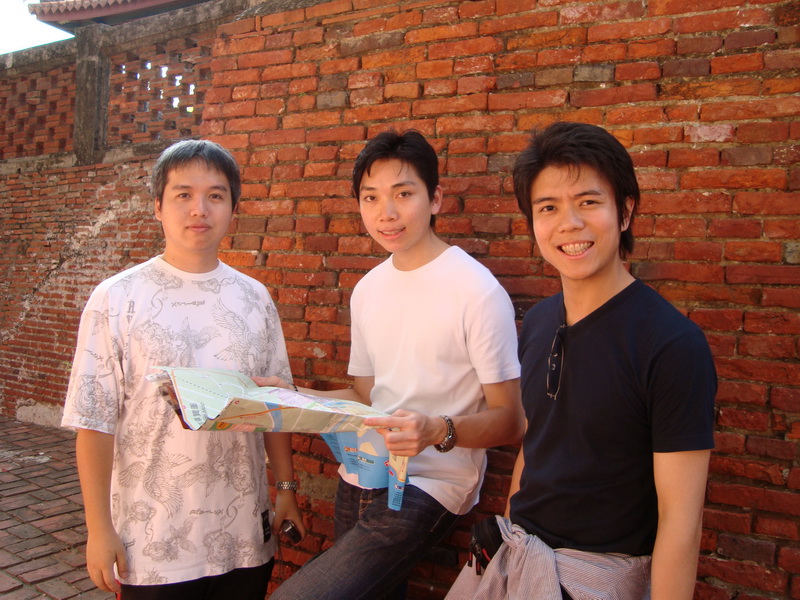
The F4 (Funny 4 + a pretty ghost) had a week-long vacation in Taiwan, doing stupid things and eating non-stop as usual. Below are some notable memories.

-Got a hip hair cut at 西門町 right after I landed, not used to it and returned to the old-fashion economist look the following day
-Surveyed the night life in Taiwan, seems like there are roughly equal numbers of attractive guys and girls
-Learn that the term 敗犬 – unmarried girls over 30 without boyfriends and kids – is widely used in Taiwan
-愛情たっぷりともっと美味しい(refers to fat duck and pigs)
-Played a birthday song for Panit with a missing note (score’s fault); the melody never to be forgotten (魔音) at night and in the morning
-Traveling around Tainan on bicycle, stopped every 10 minutes or so for food (棺材板, dan dan mian, pudding, yogurt, 蝦捲, etc.)
-Learn a bit about Taiwan history (ie. Who’s 鄭成功)
-Won a vegetable juice from Panit in a game center, but used it on telecom services instead
-Stupidly forgot my stuffs in Tainan’s hotel and went back to get it after a quick cost-benefits analysis
-A bit surprise about how 冷清 高雄 is and empirical evidence suggest that most young people do not shop or dine out but spend their time in the park
-Embark on a "discover 小林" journey
-Had a meal with my mom, sister, and her writer husband and bought one of the books he wrote
-Become more fond of cats after reading and learning more about them in a cat cafe
-無聊的小幸福 – 師大前自行車女 & MRT藝術小桂

Read Full Post »

« Newer Posts - Older Posts »