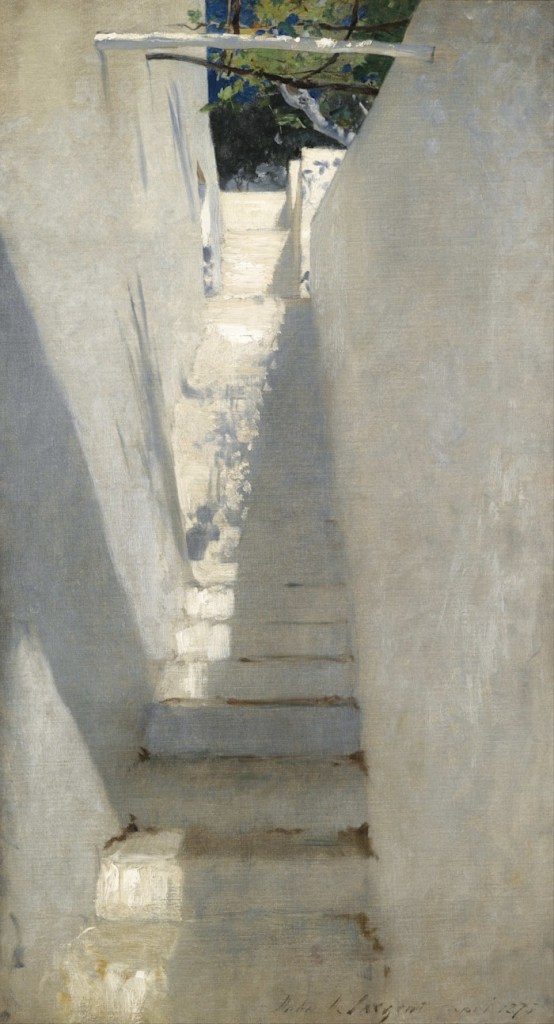
• Staircase in Capri’ (1878) by John Singer Sargent from the FT article

    Nichol Chan argues that our desire for efficiency and optimization can crowd out what matters to us.

    For things I value, such as relationships or a craft, focusing on quality and being present often helps. Reflecting on my experiences and shaping them into a narrative also helps me slow down. Perhaps the distinction is to optimize what is instrumental while being present with what is intrinsically valuable. For more instrumental things, I’m happy to optimize with simple routines I can follow most of the time, while leaving room for exploration and serendipity. And periodically reminding myself that all things are transient makes optimization seem less important than treasuring them while they last.

    P.S. Being more playful and playing games just for fun also helps.

    Excepts:

    It’s no longer about whether something feels meaningful or enjoyable. We start looking for the fastest way to learn, the smartest routine to follow and the most productive way to unwind. At some point, even rest becomes another thing to improve. 

    As a self-confessed Type A personality, I rarely leave an interest alone for long. If I pick up a new hobby, I find myself asking whether it could become content or a side hustle.

    The danger isn’t that my generation no longer values friendship, creativity or simply being present. It’s that optimisation quietly changes what earns our attention.

    If optimisation is the mindset, technology has become its greatest enabler.

    In theory, all of this should create more space for the relationships, hobbies and slower experiences we claim to value. Instead, it creates new expectations to do even more. Long before ChatGPT, sociologist Richard Sennett warned that societies obsessed with speed and flexibility slowly erode the qualities that take the longest to build: patience, craftsmanship, commitment and even a stable sense of self.

    And that’s the paradox. We built these tools to give ourselves more time for what matters, yet they often make it harder to choose exactly those things. The challenge was never that we lacked time. It was that we’ve come to believe every spare moment should be put to work.

    That’s the contradiction at the heart of the age of maxxing – we say we still value creativity, deep friendships, craftsmanship and community. We just keep building lives that make those things harder to practise.

    P.S. Enuma Okoro on not needing to be productive on holidays: “It makes me think of how rarely we take time or have the opportunity to pause and really think about the kind of holiday (or even just day off) we need or desire.”

    P.P.S Japan’s ongaku kissa (music cafes) provide a space for people to be present and just listen to music.

  • When you reflect on what someone said, the person’s thoughts and feelings take up residence in you. It’s an extension of the idea of listening as a form of hospitality. You are inviting someone into your consciousness. and the conversations you care about are the ones you carry with you in memory.

    To me, communication is key to a good relationship. I don’t mind disagreement, but avoiding difficult conversations bothers me because it leaves little chance to resolve problems, reconcile differences, or repair mistakes.

    I understand that talking to strangers can make even introverts happier, and that anyone can be interesting and teach us something. Yet I’m often impatient with certain behaviors, and my natural tendency is not to engage with strangers. Reconciling these instincts becomes harder as we get older, become more set in our preferences, and settle into our routines. At minimum, I want to become a better listener to the people I care about.

    Excerpts:

    The ability to listen to anyone has been replaced by the capacity to shut out everyone, particularly those who disagree with us or don’t get to the point fast enough.

    The executive director of a performing arts organization in Los Angeles told me, “If I really listened to the people in my life, I’d have to face the fact that I detest most of them.”

    Others said they were too busy to listen or just couldn’t be bothered.

    Listening takes effort. Like reading, you might choose to go over some things carefully while skimming others, depending on the situation. But the ability to listen carefully, like the ability to read carefully, degrades if you don’t do it often enough.

    Among the most frequently cited bad listening behaviors are:

    • Interrputing
    • Responding vaguely or illogically to what was just said
    • Looking at a phone, watch, around room, or otherwise away from the speaker
    • Fidgeting (tapping on the table, frequently shifting position, clicking a pen, etc.)

    Hearing is passive. Listening is active. The best listeners focus their attention and recruit other senses to the effort. Their brains work hard to process all that incoming information and find meaning, which opens the door to creativity, empathy, insight, and knowledge. Understanding is the goal of listening, and it takes effort.

    Our brains not only sync up the moment someone tells us something, the resulting understanding and connection influences how we process subsequent information. The more you listen to someone, such as a close friend or a family member, and the more that person listens to you, the more likely you two will be of like minds.

    To listen well is to figure out what’s on someone’s mind and demonstrate that you care enough to want to know.

    It’s what we all crave; to be understood as a person with thoughts, emotions, and intentions that are unique and valuable and deserving of attention.

    Listening is about the experience of being experienced. It’s when someone takes an interest in who you are and what you are doing.

    The most valuable lesson I’ve learned as a journalist is that everybody is interesting if you ask the right questions. If someone is dull or uninteresting, it’s on you.

    …people in long-term relationships tend to lose their curiosity for each other. Not necessarily in an unkind way; they just become convinced they know each other better than they do. They don’t listen because they think they already know what the other person will say.

    Put another way, having listened well and often to someone in the past makes it easier to get back on the same wavelength when you get out of sync, perhaps due to physical separation or following a time of emotional distance caused by an argument.

    The world is easier to navigate if you remember that people are governed by emotions, acting more often out of jealousy, pride, shame, desire, fear, or vanity than dispassionate logic.

    J. Pierpont Morgan said, “A man always has two reasons for what he does–a good one, and the real one.” Listening helps you understand people’s mind-sets and motivations, which is essential in building cooperative and productive relationships as well as knowing which relationships you’re better off avoiding.

    When you leave a conversation, ask yourself, What did I just learn about that person? What was most concerning to that person today? How did that person feel about what we were talking about? If you can’t answer those questions, you probably need to work on your listening. “If you go into every situation thinking you already know everything, it limits your ability to grow, learn, connect, and evolve,” Noesner said. “I think a good listener is someone who is open to hearing someone else’s experiences and ideas and acknowledges their point of view.”

    According to Nichols, to be a good listener means using your available bandwidth not to take mental side trips but rather to double down on your efforts to understand and intuit what someone is saying. He said listening well is a matter of continually asking yourself if people’s messages are valid and what their motivations are for telling you whatever they are telling you.

    To listen does not mean, or even imply, that you agree with someone. It simply means you accept the legitimacy of the other person’s point of view and that you might have something to learn from it.

    According to Derber, shift responses are symptomatic of conversational narcissism, which quashes any chance of connection. Shift response are usually self-referential statements while support responses are more often other-directed questions. But they have to be truly curious questions meant to elicit more information and not subtly impose your own opinion…

    The authors advise squelching the impulses to:

    • suggest you know how someone feels
    • identify the cause of the problem
    • tell someone what to do about the problem
    • minimise their concerns
    • bring perspective to a situation with forced positivity and platitudes
    • admire the person’s strength

    Being aware of someone’s troubles does not mean you need to fix them. People usually aren’t looking for solutions from you anyway; they just want a sounding board.

    Kids, like all of us, just want to be heard. Try instead, “Have you always felt this way?” or “What would quitting mean?” Look at it as an invitation to have a conversation, not as something to be fixed or get upset about.

    Regret is the second-most common emotional state, after love, she said, and the two feelings are intertwined since the most intense regret comes from neglecting those we love. Relationships most often fail due to neglect, and one of the principle kinds of neglect is not being attentive.

    I, myself, am an inveterate quote collector–I jot down any interesting, funny, or thought-provoking thing I hear, or overhear, during the course of the day. I have several notebooks as well as files on my computer filled with pithy and profound quotes from friends, family, colleagues, strangers, and of course, people I have interviewed. When you start paying attention, you’d be surprised how many things you will find worth recording. And reading back over your quote collection, you start to pick up interesting themes that are as revealing about yourself as the people you are quoting.

    Alexander Nehamas, a professor of philosophy at Princeton University and author of the treatise On Friendship, once told me, “The best friendships are those where you are able to immediately pick up the conversation where you left off because the person’s words have remained with you.” Indeed, one of the most gratifying things you can say to another person is: “I’ve been thinking about what you said.” Likewise, friends are people who can connect what you are saying in the moment to things you’ve said in the past to help you work through problems or clarify your thinking or, in some cases, just make you laugh at the association.

    Technology does not so much interfere with listening as make it seem unnecessary. Our devices indulge our fear of intimacy by fooling us into thinking that we are socially connected even when we are achingly alone. We avoid the messiness and imperfections of others, retreating into the relative safety of our devices, swiping and deleting with abandon. The result is a loss of richness and nuance in our social interactions, and we suffer from a creeping sense of dissatisfaction.

    Listening takes effort. Understanding and intimacy must be earned.

  • Think Less About Self

    Thinking less about oneself is good not only for performance but also happiness.

    Auren Hoffman thinks most of us are introspecting too much:

    Excerpts:

    people with high amounts of introspection almost ALWAYS tend to be unhappy. they become unproductive and lose their sense of meaning.

    Nolen-Hoeksema spent two decades showing that “rumination”, the (introspective) habit of cycling through your own feelings and problems, predicts onset, duration, severity, and relapse rate of depression. the more you process, the worse you actually get…

    the goal of introspection is to understand your strengths and weaknesses and to understand what you actually want in life. 

    a small minority of the population is doing real introspection. most of them are super quiet about it. they do the work, get their answer, and go back to building or whatever productive thing they can do in their life.

    a much larger group is doing rumination and calling it introspection. those people are less happy. the wellness industry keeps prescribing them more of what is making them unhappy.

    the best way to be consistently happy is to get out of your own head. stop thinking about yourself. that means stop thinking about your feelings.

    watch the happiest people you know. they are not the ones with the most resolved inner lives. they are the ones who think about themselves the least. they’re usually absorbed in a project, a craft, a problem, a family. their attention points outward and stays there.

  • Financial Times has a series of articles on games. One of my goals is to be more playful and enjoy games for their own sake. Children do this naturally, while adults tend to prioritize efficiency, whether at work or in parenting, which can make us less patient and playful.

    The documentary on Marty Short shows that adults can remain playful. He’s funny, has a good attitude toward life, and is loved by his friends and family. I hope I can learn to be less serious, more playful, and embrace a little more chaos.

    As this review summarized: “The moral of this story is that movies come and go, series debut and get cancelled, but the lasting impressions come from time spent with loved ones. Short’s tale reflects a need to embrace the time one has with friends and family since he knows all too well how quickly life passes.” Here’s another review.

    Excerpts from Tim Hartford:

    A good game can push us to remarkable feats of concentration, the mastery of complex information or bursts of physical effort that leave us gasping (or, once we reach a certain age, regretting our lack of warm-up). My own gaming activities include learning not only the rules but also some of the best tactics for a bewildering series of board games, and pushing through my shyness and introversion to play in long role-playing game sessions that are nothing more than intense social interactions in disguise. I’ve even been trying to do handstands, although I can assure you that standing on two feet is easier. None of this needless striving would be happening without the pull of the game.

    The same is true of many artistic pursuits. If you want to capture someone’s likeness, you could pull out a smartphone and snap a photograph, or you could ask them to sit while you draw or paint. There’s no doubt that the phone camera is the easier option, but as the writer and creative guru Austin Kleon declares, “a good hobby should look a little exhausting”.

    Excerpts from C Thi Nguyen on Bernard Suits’ philosophy and why play is the core of a meaningful life:

    Imagine, says Suits, utopia — some future paradise where technology has solved all our practical problems. We have perfect medicine, unlimited energy and boundless resources. What would we do with our time? We would play games, says Suits, or we would be bored out of our minds. And if playing games is all we do in utopia, then games must be the meaning of life…

    The book is an argument for the centrality of play. For him, play is not just a side dish for the main meal of work. Play is at the core of a meaningful life.

    Underneath the hood, Suits’ argument is Aristotle to its bones. For Aristotle, a good life — a truly meaningful life — lay not in the creation or accumulation of stuff or the achievement of outcomes, but in the process of doing itself, in the rich exercise of our full human capacities…

    Suits found the deepest illumination of Aristotle’s point in the simplest human activity: playing games. Suits provides, and defends, his definition. To play a game, he says, is to voluntarily take on unnecessary obstacles to make possible the struggle to overcome them.

    To play a game, therefore, is to be inefficient on purpose. When you run a marathon, you are trying to get to a particular spot in space, but you avoid the most efficient ways to get there…Which means, for Suits, that the struggle must be an essential part of the true value. What you care about can’t just be the bare outcome by itself…

    Games sculpt a particular way of doing things. Football tells you not to use your hands, so you learn how much grace and control you can get out of your feet. Rock climbing tells you to go up, but forbids the standard human tools. No ladders, no helicopters, no grappling hooks. You are devoted instead to balance, bodily precision and delicate movement…

    Games rub our faces in the value of difficult struggles, for their own sakes. If all that mattered in life was the bare outcome — the product, the money, the extractable good — if human action was just a means to some independent ends, then playing games would be utterly irrational.

    Or you could think: games are important, and the mindset wholly devoted to outcomes and extractable products has missed out on the centre of human life…

    Most serious adults — even people who research play — are usually anxious to show how play is actually, secretly, useful for actual adult stuff. They are anxious to show how play encourages some future productivity. Chess teaches logic, football teaches teamwork, Minecraft builds future engineers. Or, at the very least, play is useful because it relaxes and restores you, so you can renew your vigour and get back to work.

    Suits argues something different. He argues that play itself is the point, and that we work in order to survive so that we might play…

    Here’s my suggestion: to “work” is to perform activities to create outcomes that are set by something external. When you work, you are making what the world tells you to make. Maybe you’re gathering food, because biology tells you you have to eat. Maybe you’re earning money, because the world says you need money to buy food and shelter and medicine. Maybe you’re making products, because the world wants something specific from you — planks of wood, a ride to the airport.

    But “play” is different. You still have goals and struggles, but your goals are up to you.

    With games you choose the goals because they give you the kind of action you want, the kind of involvement you want. If you don’t like a game, you can switch games. You can change the rules, you can change the goals. You can make it so hard that you probably will lose. You can change the points, because the points aren’t what matters. Your own joyous action is.

    Design Matters’ podcast with C. Thi Nguyen. Sports and art are both games in his view.

    Here’s Maria Popova on Bernard Suits’ book.

    Excerpts:

    Prudential actions (e.g., those actions we ordinarily call work) are self-defeating in principle. For prudence may be defined as the disposition 1) to sacrifice something good (e.g., leisure) if and only if such sacrifice is necessary for obtaining something better (e.g., survival), and 2) to reduce the number of good things requiring sacrifice — ideally, at least — to zero. The ideal of prudence, therefore, like the ideal of preventive medicine, is its own extinction. For if it were the case that no sacrifices of goods needed ever to be made, then prudential actions would be pointless, indeed impossible. 

    The only argument against living the life of the Grasshopper arises from the contingent fact that at present one dies if one does not work. The answer to that argument is that my death is inevitable in any case. For if I am improvident in summer, then I will die in winter. And if I am provident in summer, then I will cease to be the Grasshopper, by definition. But I will be either provident or improvident in summer; there is no third alternative. Therefore, either I die or I cease to be the Grasshopper. But since I am just the Grasshopper, no more and no less, dying and ceasing to be the Grasshopper are one and the same thing for me. I cannot escape that logic or that fate… Everyone alive is really a Grasshopper… Everyone alive is in fact engaged in playing elaborate games, while at the same time believing themselves to be going about their ordinary affairs. Carpenters, believing themselves to be merely pursuing their trade, are really playing a game, and similarly with politicians, philosophers, lovers, murderers, thieves, and saints. Whatever occupation or activity you can think of, it is in reality a game.

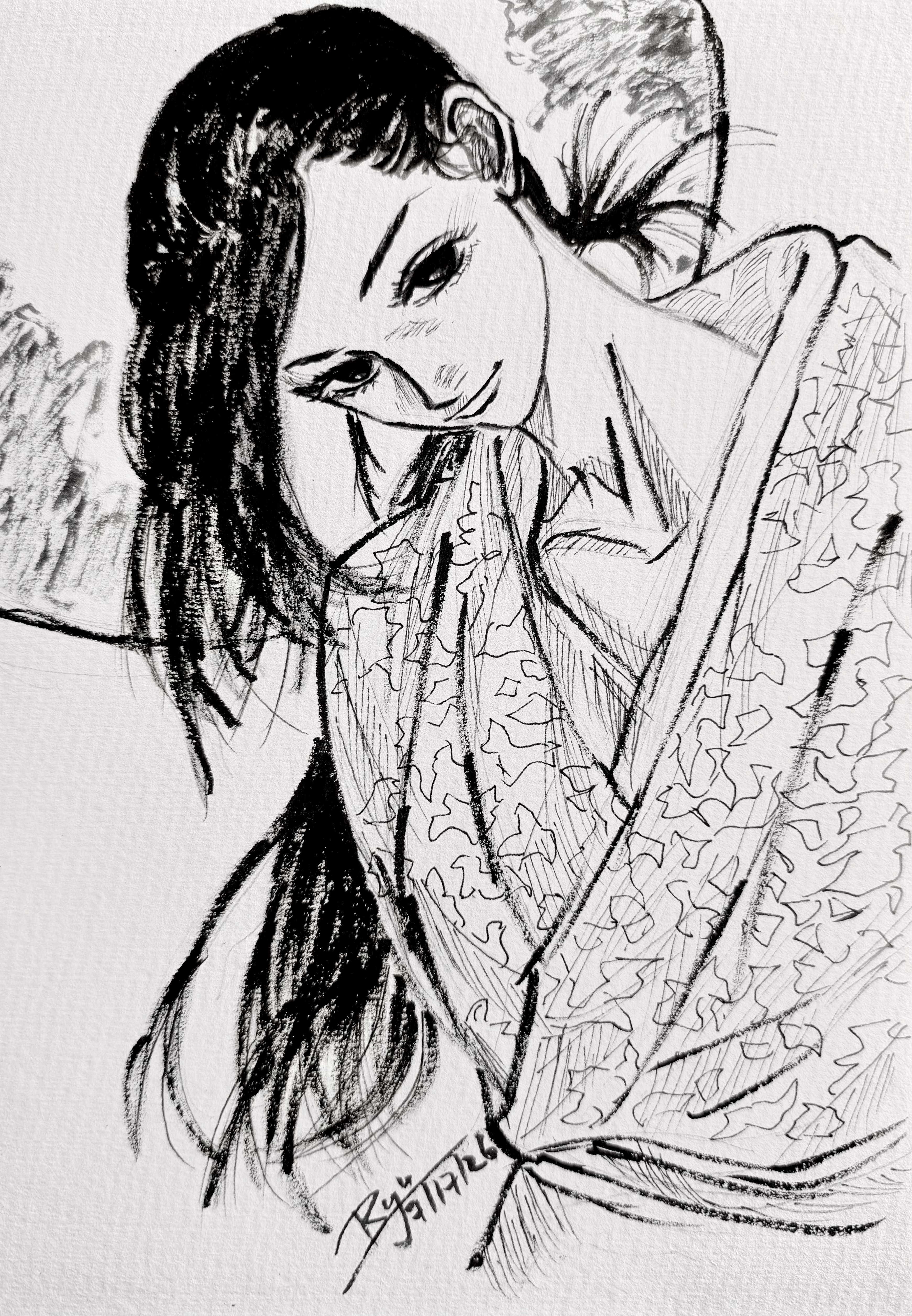
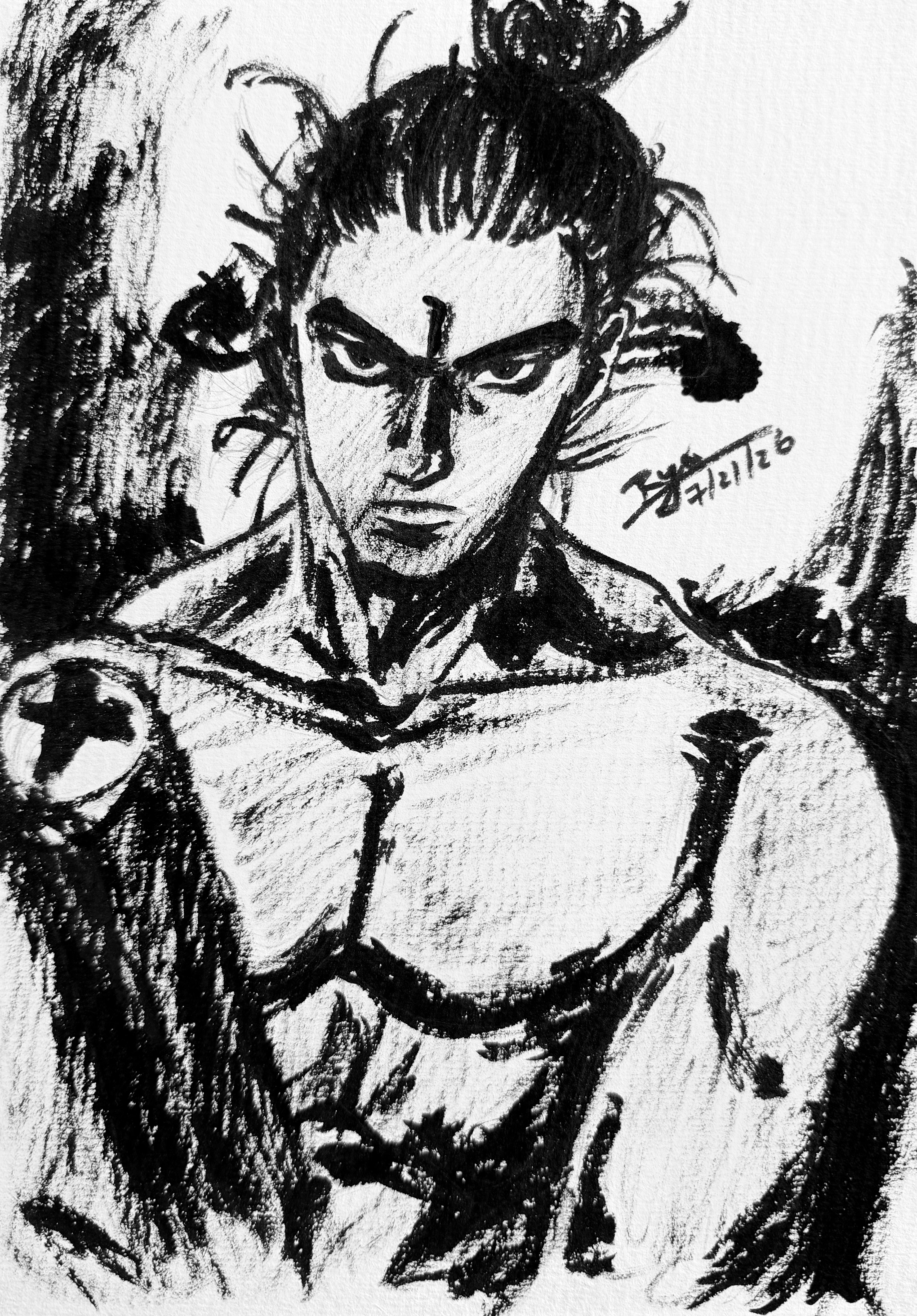
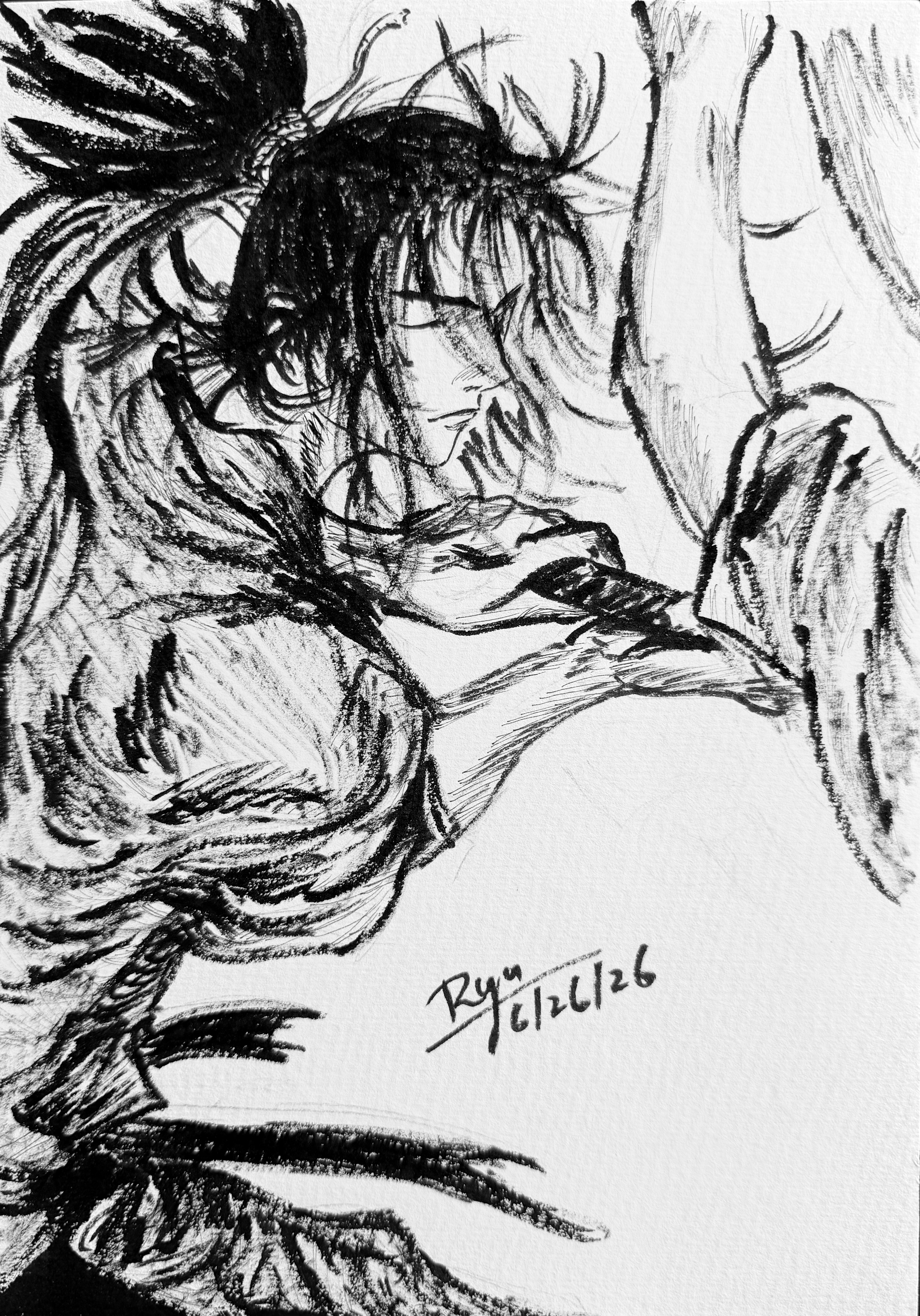
  • Ink Drawing: Vagabond III

  • Ya Kun: Our go to local breakfast place

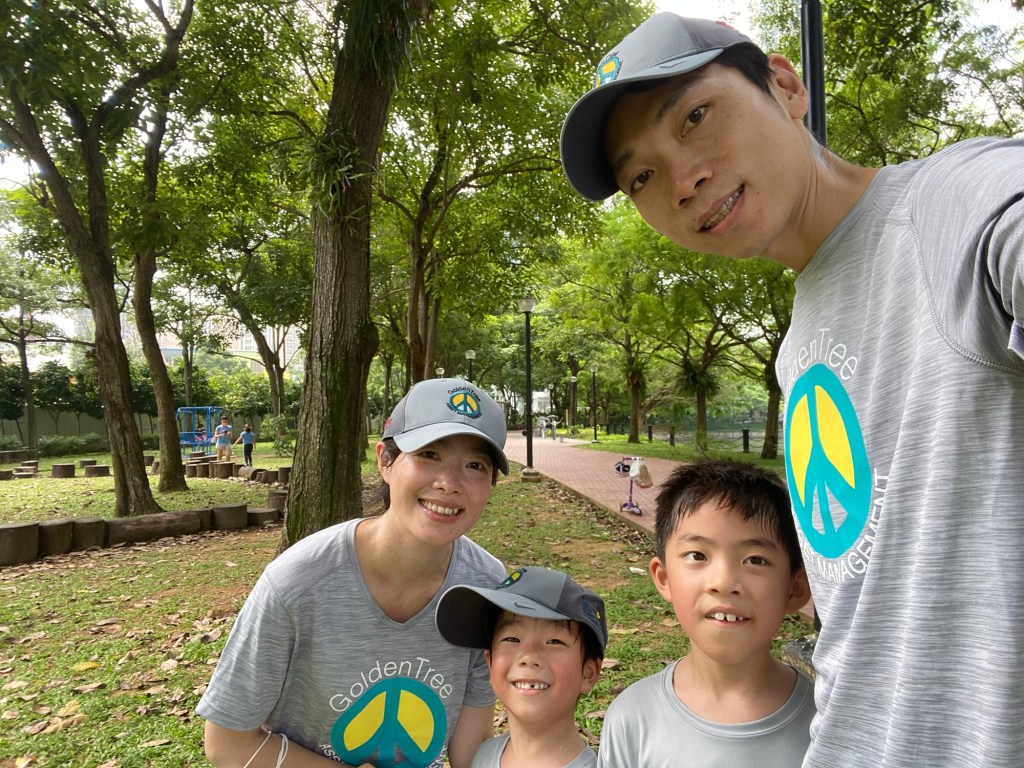
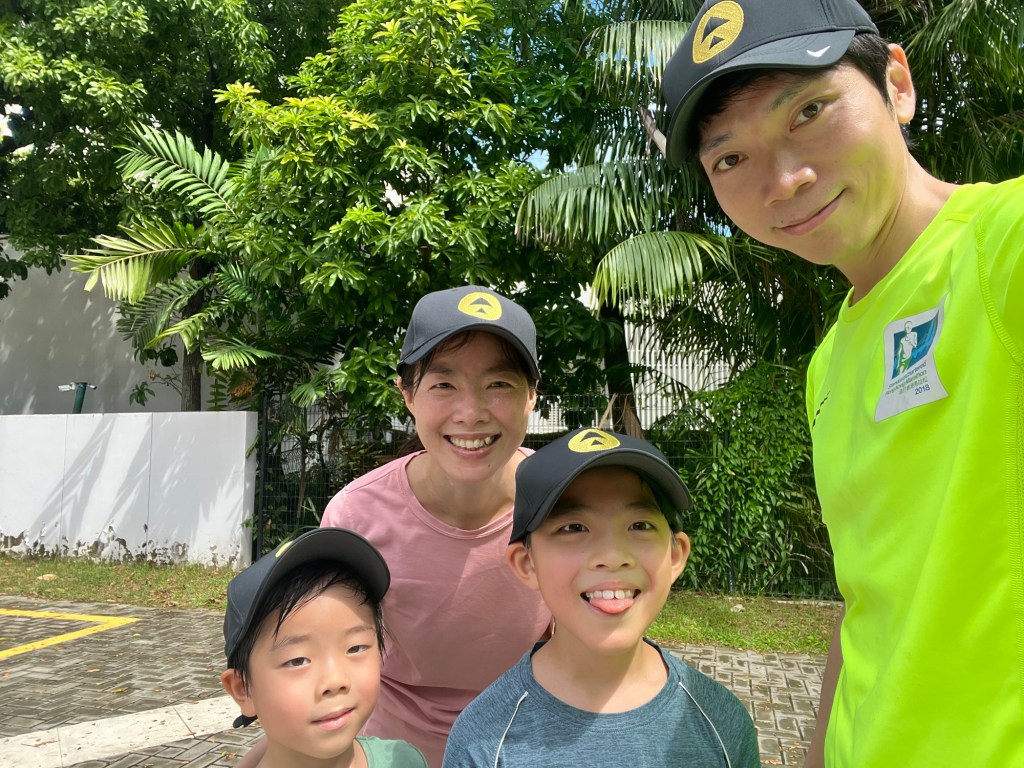
    I like routines and rituals. For the past two years, our family has had a quarterly 5K run followed by a hearty breakfast. It is also a day when we play board games in the evening instead of our usual anime or video games. It gives us an opportunity to spend time together while doing something fun and healthy.

    A quarterly event is easy to commit to, with flexible schedule. The activity is simple and it costs little. We usually have Ya Kun toast with coffee or milk tea, or a full English breakfast when we want something more substantial.

    I think this is the kind of simple family ritual we will remember years from now. It also reminds me to treasure our time together. If we continue until my older boy turns 18, we have only about 25 more of these runs together. That makes each one feel a little more precious. Still, we can always come up with new rituals that we all enjoy.

    Here’s Enuma Okoro on the road back to routine.

    Excerpts:

    Returning to the routine of life and away from summer fun is also returning to the recognition that most of life is less about holidaying and more about choosing the battles you’re willing to risk getting in trouble for — because you believe in whatever it is you’re committed to, be it a lifestyle, a political stance or simply making your voice heard in a society that’s always telling you to be “good” at any age.

    This painting feels to me as much about our relationship with the season as it is a depiction of a landscape. As summer winds down and the days get shorter, it can feel as if we are losing a beautiful season. But Levitan’s painting reminds me that, as with much of life, when something ends there is always something else beginning. And even in the return to regular routines there will be encounters with many things and people that will offer us fresh and unpredictable experiences. What a stunning perspective this work offers us of the unknown possibilities that might lie ahead, even in the midst of the expected.

    P.S. Routines may be good for our well-being. I’m not energetic by nature, and I generally feel better when I can stick to my routines, including getting some exercise every day.

    P.P.S. Tim Urban on family time: “It turns out that when I graduated from high school, I had already used up 93% of my in-person parent time.”

  • Stamps I came across recently

    Rebecca Rose laments that we may be entering a post-postcard world. I collect postcards and used to send them to friends when I traveled. Like a treasure hunt, I enjoy finding designs I like, postcards depicting my favorite works of art (like Ben Okri below), or places and moments I want to remember.

    I also love letters. When I was young, writing to loved ones was more common, and I enjoyed choosing stationery that complement the message. Letters required effort, while postcards offered a simpler way to share a thought. Now even postcards seem too troublesome, replaced by texts and AI-generated images and videos.

    Cards and letters can become obligatory or add to someone’s clutter. But occasionally, a thoughtfully chosen postcard or letter becomes a lasting memento, something we return to years later.

    Excerpts from FT’s interview with poet and Novelist Ben Okri:

    I have a collection of tarot cards. It was never intentional…Over the years I seemed to find myself in places where unusual tarot cards were being sold. For example, in Viareggio in northern Tuscany there is a magic shop that is never open. Inside, a black cat sits at the window staring at you. On the last day of my last holiday there, the shop was open. The moment I went in, I felt out of sorts. I noticed broomsticks and bottles with magnified eyeballs. Just as I was about to flee, I saw a black magic tarot pack on the cashier’s table. A severe‑looking woman stared at me so intently that I bought the pack. I have been collecting tarot packs ever since.

    [This reminds me of my favorite Ghibli anime Whisper of the Heart. Being open to this kind of serendipity makes life more memorable.]

    An indulgence I would never forgo is walking my own path. Even at this stage of my writing life, I still encounter people who try to prescribe what I should write and what direction I should travel in as a writer. I travel my own path. It’s all I can do…

    Some of my best ideas have come from long walks. It is the most therapeutic and inspiring activity. The best walking is without a purpose, walking as musing, as meditation. Walking is magic. It took us a long time to achieve the feat of standing on two legs. Dancers say that when we walk, we are merely preventing ourselves from falling. When we walk, we defy our fall. To walk is to switch on the part of us that muses, dreams, thinks freely and is open to extraordinary ideas. When people tell me they’re having trouble with their work, I tell them to go for a long walk…

    I’ve recently rediscovered my postcard collection from museums across the world. Wherever I travel I visit the local museums and buy postcards of favourite works of art. They are an aide mémoire and a constant education. One of my favourites is Kazimir Malevich’s Black Square. I once stood in open-eye meditation of the original for more than 30 minutes.

    My favourite building is the National Gallery. It houses one of the most extraordinary collections of art in the world. I learnt to write at the same time as I learnt to look at paintings. For many years the National Gallery was something of a second home to me. I got to know the collection so well that I could tell where every painting was. Sometimes when I could not sleep at night, instead of counting sheep, I would mentally tour the collection.   

    I don’t have a wellbeing guru. I believe in simplicity of living. My guru is a good walk, a good book, a few good friends, family, meditation, modest exercise, something to be working on, nature, laughter, plenty of water to drink, good breathing, silence.

    The thing I couldn’t do without is meditation. And by meditation I mean turning inward, or upward, paying attention to the breath, stilling the mind. Meditation is getting in touch with the reality beneath reality, getting in touch with the source, opening oneself to the light. There are many kinds of meditation. Some do walking meditation, some do breath meditation, some do it with their eyes open, and some with their eyes shut. It introduces a quality of calm into one’s life and restores things to their true perspective. It is a natural part of being. We all meditate but don’t know that we do. When we sit by a window and look out, hardly aware of our thoughts, that is meditation. Moments before we sleep, with our minds like a barque on a gentle sea – that is meditation. It brings us back to ourselves, sends the ego on holiday, and restores to us an inner fullness we last experienced perhaps as children.

    P.S. Chine McDonald on retro revival.

    Excerpts:

    For many, nostalgia provides comfort. It takes us back to “the good old days” we associate with the freedom and happiness of our younger years. In what feels like an increasingly fractured and turbulent world, we long for what we perceive as simpler times. 

    It is not simply that people are fascinated with old things, but that in an age of infinite digital abundance, one where the future feels deeply uncertain, people long for things they can engage with physically and which remind them of a lost golden age.

    What is particularly fascinating is that the analogue economy — driven by demand for printed books, retro music and cameras — is being bolstered by Gen Z. Younger generations seem to be nostalgic for a world they never experienced; a term psychologists call anemoia.

    What we are experiencing today is a very 21st-century kind of nostalgia. The longing is not really for floppy disks or Duran Duran. Rather, it is for something harder to name: a slower relationship with time, with each other and with ourselves. 

  • I liked the movie adaptation Worlds Apart and decided to watch the anime. It didn’t disappoint. I enjoyed the slow development of Makio and Asa’s relationship, as well as the mundane conversations Makio has with her friends and loved ones.

    It reminded me that, whether adults or teenagers, we are all delicate beings. We may never truly understand another person, but we can still try to be considerate, accepting, and nonjudgmental.

    I relate most to Makio, even though our lifestyles are completely different. I like her honesty, sensitivity, and clear sense of who she is and what she likes. I also like the opening song “Sonare” by TOMOO.

    Quotes:

    Makio: Write with the intent to die and kill. Strike, train, sharpen with the intent of dying. Risk your life to kill. That’s what it means to write. [Similar to Teshima’s advice from Draw This, Then Die!]

    Asa: I wanna be the me I wanna be!

    Makio: Who you are, what you love, what you don’t love…How you’re going to live…One day, maybe you’ll find out. One day…

    Asa: “Is standing out a good thing or a bad thing? I’m not the type to stand out. I’m not growing any taller, I’m not in love, and I can’t write lyrics. So if I try to stand out, is it, like…Like, it’s not my place, or like, it’s not me? So I thought, maybe it’s a bad thing?

    Motsu:…I think the whole being you thing is totally overrated. I did that, and I regret it. Being the person who always understands. Being the person who never fights back. Being the person who always prioritizes others. Being the person who never cries or screams. I regret ever trying to be me. I kept thinking about how to be me and lost sight of what I really wanted. So I quit. Asa, you see, I think that when you really want to do something, that’s what you should do. Why not? Who cares?

    Tono: You have an unshakeable sense of self.

    Shingo:…No, that isn’t true at all…I really wish I did. If you feel like I do, then maybe that’s why. That thing you mentioned earlier. It’s because I quit trying to stay on it…

    Rites of initiation into men’s circles…Maybe that’s what to call it. I decided that I wouldn’t do any of that anymore, and all sorts of things in life got a whole lot easier. The man who takes on the greater risk wins. The man who can objectify women more wins. The man who has it easier and enjoys more things wins.

    The truth is that you’re dying from the pressure, but you grin and bear it because you don’t know that there’s anywhere else you can be. You think it’ll all be over if you fall from that ledge, so you hang on for dear life.

    There were plenty of other selves that you could’ve been. There was no need to test your worth in a chicken race…I got off it, ran away, and I guess you could say I finally became human, or that I finally found my center…Up until recently, l lived trying to make things work with others. That’s why I have great respect for people who need things to be a certain way. People who have a real self.

    Makio: I’d never write anything for someone else. Or rather, no one acts for the sake of others. That goes for writers and everyone else…but regardless of whether you do something for someone else or not, others’ emotions and actions are not something that you evoke. The vast majority of actions bear no fruit. You receive no thanks or reward for them. The world will not change. You should think that way…But you know, acting despite know this truth is respectable. That is what I think.

    Asa: My goal…is for a depressed friend of mine to listen and feel better…Back then, I didn’t have anything that I truly resented. Didn’t know the colour or shape of despair. I didn’t understand any of it. But even so, as foolish as it was, I believed that my tiniest actions, surely, surely, could change the world…

  • The message of the Inner Game is simple: focus. Focus of attention in the present moment, the only one you can really live in, is at the heart of this book and at the heart of the art of doing anything well.

    I had long heard athletes praise this classic, so I read it to see whether it could help my development as an adult badminton learner. I didn’t find the YouTube summaries useful, but I liked the book.

    Its central idea is non-judgmental awareness: stay mindful, observe what is happening, and let the body respond. It resembles meditation and is easier said than done. I do not see myself as particularly judgmental when learning, but the approach may be harder for beginners, who still have many bad habits and less capacity for awareness because there are many things to focus on.

    Reaching a high level requires time and repetition. There is no shortcut. For me, the idea may be most useful during performances or competitions, when concern about others’ perceptions distracts me from the activity and lowers my performance.

    Excerpts:

    This is the game that takes place in the mind of the player, and it is played against such obstacles as lapses in concentration, nervousness, self-doubt, and self-condemnation. In short, it is played to overcome all habits of mind which inhibit excellence in performance.

    Players of the Inner Game come to value the art of relaxed concentration above all other skills; they discover a true basis for self-confidence; and they learn that the secret to winning any game lies in not trying too hard.

    …the key to better tennis–or better anything–lies in improving the relationship between the conscious teller, Self 1, and the natural capabilities of Self 2.

    Getting it together mentally in tennis involves the learning of several internal skills: 1) learning how to get the clearest possible picture of your desired outcomes; 2) learning how to trust Self 2 to perform at its best and learn from both successes and failures; and 3) learning to see “nonjudgmental”–that is, to see what is happening rather than merely noticing how well or how badly it is happening.

    In short, “getting it together” requires slowing the mind. Quieting the mind means less thinking, calculating, judging, worrying, fearing, hoping, trying, regretting, controlling, jittering, or distracting. The mind is still when it is totally here and now in perfect oneness with the action and the actor. It is the purpose of the Inner Game to increase the frequency and the duration of these moments, quieting the mind by degrees and realising thereby a continual expansion of our capacity to learn and perform.

    The first skill to learn is the art of letting go the human inclination to judge ourselves and our performance as either good or bad.

    Letting go of judgments does not mean ignoring errors. It simply means seeing events as they are and not adding anything to them.

    Judgment result in tightness, and tightness interferes with the fluidity required for accurate and quick movement. Relaxation produces smooth strokes and results from accepting your strokes and they are, even if erratic.

    No matter what a person’s complaint when they have a lesson with me, I have found that the most beneficial first step is to encourage them to see and feel what they are doing–that is, to increase their awareness of what actually is.

    …I again ask him to observe his racket and to tell me exactly where it is at the moment of bounce. As the player finally lets himself observe his racket with detachment and interest, he can feel what it is actually doing and his awareness increases. Then, without any effort to correct, he will discover that his swing has begun to develop a natural rhythm. In fact, he will find the best rhythm for himself, which may be slightly different from what might be dictated by some universal standard called “correct.” Then when he goes out to play, he has no magic phrase that must be repeated, and can focus without thinking.

    Clearly, positive and negative evaluations are relative to each other. It is impossible to judge one event as positive without seeing other events as not positive or as negative.

    The first inner skill to be developed in the Inner Game is that of nonjudgmental awareness. When we “unlearn” judgement we discover, usually with some surprise, that we don’t need the motivation of a reformer to change our “bad” habits. We may simply need to be more aware.

    Acknowledgment of one’s own and another’s strengths, efforts, accomplishments, etc., can facilitate natural learning, whereas judgments interfere. What is the difference? Acknowledgment of and respect for one’s capabilities support trust in Self 2.

    Getting the clearest possible image of your desired outcomes is a most useful method for communicating with Self 2, especially when playing a match.

    “Asking for qualities” describes this other kind of role-playing…”Imagine that I am the director of a television series. Knowing that you are an actor that plays tennis, I ask if you would like to do a bit part as a top-flight tennis player…What I’m mainly interested in is that you adopt professional mannerisms, and that you swing your racket with supreme self-assurance. Above all, your face must express no self-doubt. You should look as if you are hitting every ball exactly where you want to. Really get into the role, hit as hard as you like, and ignore where the ball is actually going.”

    Letting go of judgments, the art of creating images, and “letting it happen” are three of the basic skills involved in the Inner Game.

    I made the point that a great deal of technique can be learned naturally by simply paying close attention to one’s body, racket, and ball while playing. The more awareness one can bring to bear on any action, the more feedback one gets from experience, and the more naturally one learns the technique that feels best and works best for any given player at any given state of development. Bottom line: There is no substitute for learning from experience.

    Ironically, the over tightening of these muscles has the opposite effect on power. It reduces power, by making it more difficult for the wrist and elbow to release freely. So again, the important point is to observe the tightness of your muscles so that you can experientially find the degree of tension that provides the best results.

    “What I consider to be the right technique for my swing is ever-changing day by day. My model is always being destroyed and rebuilt as I learn more and more. My technique is always evolving.” Self 2’s nature is to evolve every chance it gets.

    When you try hard to hit the ball correctly, and it goes well, you get a certain kind of ego satisfaction. You feel that you are in control, that you are master of the situation. But when you simply allow the serve to serve itself, it doesn’t seem as if you deserve the credit. It doesn’t feel as if it were you who hit the ball. You tend to feel good about the ability of your body, and possibly even amazed by the results, but the credit and sense of personal accomplishment are replace by another kind of satisfaction.

    But of course the instant I try to make myself relax, true relaxation vanishes, and in its place is a strange phenomenon called “trying to relax.” Relaxation happens only when allowed, not as a result of “trying” or “making.”

    As one achieves focus, the mind quiets. As the mind is kept in the present, it becomes calm. Focus means keeping th mind now and here. Relaxed concentration is the supreme art because no art can be achieved without it, while with it, much can be achieved.

    There are many ways to increase one’s awareness of muscle feel. One is to take each of your strokes in slow motion. Each can be performed as an exercise, in which all attention is placed on the feel of the moving parts of the body.

    The practical consequences to your volley of increasing your alertness are obvious. Most volleys are missed either because contact is made too far behind the player, or because they are off-center. Becoming more aware of the present makes it easier to know where the ball is at all times and react soon enough to meet it at the instant of your choice. Some people think that they are just too slow to return a hard shot when they are at net. But time is a relative thing, and it really is possible to slow it down.

    Alertness is a measure of how many nows you are alert to in a given period.

    Phil Jackson, coach of Michael Jordan and six-time NBA Champions the Chicago Bulls, describes the state of Self 2 focus very well in his book Sacred Hoops: “Basketball is a complex dance that requires shifting from one objective to another at lightning speed. To excel, you need to act with a clear mind and be totally focused on what everyone on the floor is doing. The secret is not thinking. That doesn’t mean being stupid; it means quieting the endless jabbering of thoughts so that your body can do instinctively what it’s been trained to do without the mind getting in the way. All of us have flares of oneness…When we’re completely immersed in the moment, inseparable from what we’re doing.”

    I was reading a description of the zone by Bill Russell, the famous basketball player for the Boston Celtics: “At that special level all sorts of odds things happened….It was almost as if we were playing in slow motion. During those spells I could almost sense how the next play would develop and where the next shot would be taken. Even before the other team brought the ball in bounds, I could feel it so keenly that I’d want to shout to my teammates, ‘It’s coming there!’–except that I knew everything would change if I did. My premonitions would be consistently correct, and I always felt then that I not only know all the Celtics by heart but also all the opposing players, and that they all knew me. It seems less odd to me now. It seems more like, yes, that’s the way it is, that’s the way it should be all the time. We can be focused. We can be conscious.”

    It is when competition is thus used as a means of creating a self-image relative to others that the worst in a person tends to come out; then the ordinary fears and frustrations become greatly exaggerated. If I am secretly afraid that playing badly or losing the match may be taken to mean that I am less of a man, naturally I am going to be more upset with myself for missing shorts. And, of course, this very uptightness will make it more difficult for me to perform at my highest levels. There would be no problem with competition if one’s self-image were not at stake.

    Winning is overcoming obstacles to reach a goal, but the value in winning is only as great as the value of the goal reached. Reaching the goal itself may not be as valuable as the experience that can come in making a supreme effort to overcome the obstacles involved. The process can be more rewarding than the victory itself.

    Focus means not dwelling on the past, either on mistakes or glories; it means not being so caught up in the future, either its fears or its dreams, that my full attention is taken from the present. The ability to focus the mind is the ability to not let it run away with you. It does not mean not to think–but to be the one who directs your own thinking. Focusing can be practiced on a tennis court, chopping carrots, in a pressure-packed board meeting, or while driving in traffic. It can be practiced when alone or in conversation. It takes as much trust to fully focus attention when listening to another person without carrying on a side conversation in your own head as it does to watch a tennis bal in all its detail, without listening to Self 1’s worries, hopes, and instructions.
  • Oliver Burkeman argues most of us seek the feeling and experience of being alive:

    Excerpts:

    The concept that sits right at the heart of a sane and meaningful life, I’m increasingly convinced, is something like aliveness.

    And so an excellent question to ask yourself – when you’re facing a tough decision, say, or wondering if you’re on the right track – is: “Does this feel like it’s taking me in the direction of greater aliveness?”

    Crucially, aliveness isn’t the same as happiness. As the Zen teacher Christian Dillo explains in his engrossing book The Path of Aliveness, you can absolutely feel alive in the midst of intense sadness. 

    More subtly, it feels like our own aliveness is what’s at stake when we’re urged to get better at prompting LLMs to provide the most useful responses. Maybe that’s a necessary modern skill; but still, the fact is that we’re being asked to think less like ourselves and more like our tools. It makes you wonder if Wendell Berry had it right when he wrote: “It is easy for me to imagine that the next great division of the world will be between people who wish to live as creatures and people who wish to live as machines.”

    Because I suspect that a certain form of naivete may be a precondition for aliveness. In a world where tech commentators confidently declare that we poor ignoramuses haven’t even begun to get our heads around what’s barreling down the tracks towards us, I think it’s good to stay fully, even slightly foolishly, committed to the idea that humans doing human things, with other humans, is and will remain at the vital heart of human existence. Because otherwise what on earth’s the point?