Feeds:
Posts
Comments

Archive for the ‘Uncategorized’ Category

Two Ted Talks on how technology and human ingenuity will likely make the future better. The speakers are optimistic, as opposed to a more pessimistic take from Robert Gordon. Erik Brynjolfsson is also optimistic about growth, but thinks human will need to “race with/against the machines”, a theme not dissimilar from Tyler’s latest book Average is over (even though most people seem to associate Tyler with The Great Stagnation, he’s probably more a realistic optimist than a pessimist).

Where do I fall on the debate? I don’t think anyone can predict what will happen that far out, but my bias is that things will continue to get better over the next 100 years or so. I’m not sure where this optimism bias arises from, but it probably serves me well personally.


Read Full Post »

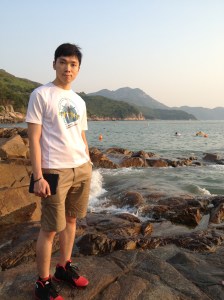
It relaxes my mind. It’s a good way to get closer to nature, spend time with family/friends, and do some exercises. I’m lucky to live in a place where there are many accessible hiking trials. Spending a day out hiking and reading (during commute and breaks) is a cheap and excellent way to recharge.

IMG_3533 IMG_3535IMG_3529IMG_3512

Read Full Post »

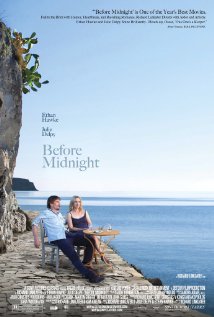
I still remember how much I enjoyed watching Before Sunrise (here‘s my previous post on the movie).  It portrays the kind of relationship I’d like to be in, not to mention the beautiful, idealistic encounter. I equally enjoyed Before Sunset: a more realistic take on relationship and life. Nevertheless it’s still a short encounter with the two main characters having a lovely conversations and stroll around Paris.

Another 9 years we learn that Jesse and Celine stayed together. They continue to share great chemistry and enjoy each other’s company, but these alone might not be enough to keep their relationship going. The old saying that it’s easy to fall in love but hard to stay in love rings true.  I used to think if two people love each other and are willing to communicate calmly then any problems can be resolved. But things don’t always work that way. Men and women tend to approach things differently. Differences in personality, values, and objectives also make communication more difficult, and people are bias and not necessarily truth seeker. The biggest obstacle to the “if we communicate then everything will be fine” is emotion. Emotion is necessary for a spontaneous and fun relationship, but it also makes the kind of communication needed to resolve issues more difficult. I guess to maintain a relationship, we need to know when to be rational and when to be emotional. Some self-deception or illusion about the relationship and more tolerance would probably help as well.

MV5BMjA5NzgxODE2NF5BMl5BanBnXkFtZTcwNTI1NTI0OQ@@._V1_SX214_

Read Full Post »

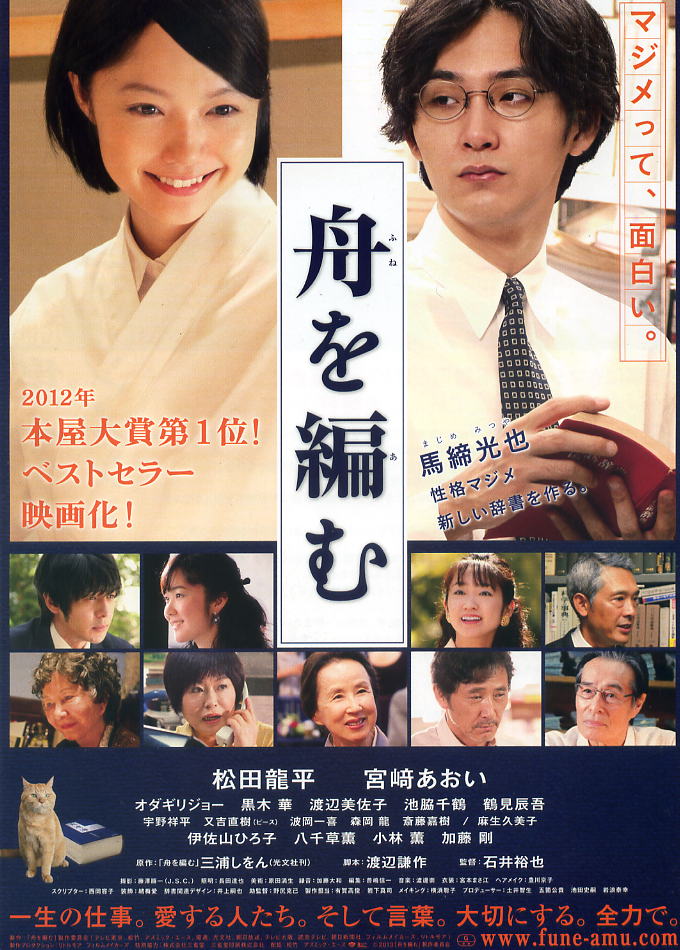
This Japanese movie talked about a young introvert who dedicated over a decade of his life to create a dictionary. In today’s fast paced society, a simple yet meaningful lifestyle seems like something many would feel nostalgic about. I admire craftsman who dedicates oneself to a certain ideal. It reminds me of the documentary Jiro Dreams of Sushi [the sushi is really good by the way] as well as many other Japanese stories.

Here is a nice review from IMDB:

The Great Passage is a rare story describing how a serious, quiet and shy young man pursues his massive project at work with great diligence and passion while winning his dream girl along the way.

When low-keyed, non-expressive and introvert Mitsuya Majime (meaning serious in Japanese! Played by Ryuhei Matsuda) is transferred to a new position in his publishing company to compile a dictionary, his life is forever changed. Originally a misfit salesman, Majime is perfect for his new role as editor. In fact, the clumsy young man is an outcast even in this society which values outgoing and talkative personalities. Equally out of date is the project he is working on – a paper dictionary in a society with online and mobile communication.

Majime may be old fashioned: he works in a company which clings to an old dream to help users understand reality in the wide ocean of knowledge, by means of patiently weaving the boat of dictionary, “The Great Passage.” He himself is also conservative in expressing his feelings to the girl of his dream, also granddaughter of his landlady, Kaguya Hayashi (Aoi Miyazaki) who aspires to be a chef in competitive Tokyo.

Yet we cannot help but admire Majime’s dedication to his work: he meticulously looks for sources of new words and their explanations; he pays immense effort in researching the type of paper with the right touch for the dictionary. When the deadline edges in, he even camps in the office with his temporary helpers to iron out the mistakes until they finally meet the deadline.

Equally serious is how he approaches the muse of his life by offering explanations of words to coincide her careful action in the kitchen. What a nice merge of both threads in the movie! It was amusing when we see how he struggles to verbalize his feelings for her. Afterall, feelings have to be expressed.

Compiling a dictionary in an ever changing world could be daunting and overwhelming. But the director made it very interesting and almost sacred, not to mention the funny scene when the editors stay in a fast food chain to “overhear” youngsters’ conversations. The romantic and hilarious courtship almost convince us that when there is genuine love and care, perhaps whatever you say does not matter that much: action often speaks better than words. In the same token, ironically, despite all the detailed explanations of the dictionary, perhaps sometimes the highest level of communication does not need, or cannot be expressed by, any words.

This is also a movie on realizing our dreams by intense focus and persistence: whether it is becoming a chef or compiling a comprehensive dictionary. Yes, it may take a whole decade to complete, but it is well worth the effort, especially in this fast changing world. The fact that they remain in the same old house and office all through the years echoes the themes that in this vast sea of mobility and changes, there is a need to anchor on something/someone constant before we can move forward.

The cast are excellent. Matsuda and Miyazaki shine in portraying the young, shy and kind lovers. You can’t help feeling sorry and impatient for them. But in the end, I guarantee you will admire and appreciate their painstaking effort, both in love and in work.

fune-wo-amu-flyer-2

Read Full Post »

The Paleo Manifesto: Ancient Wisdom for Lifelong Health

Just finished reading this book about health using an evolutionary perspective. It makes a lot of sense to me. John gives a good overview and many sensible advice. I’m a convert.

Here’s the author’s website: http://huntergatherer.com/

Read Full Post »

Average is over: Powering America Beyond the Age of the Great Stagnation

Self-recommending. Tyler argues that as we get better at measuring productivity, market will increasingly reward people who can work well with machines/artificial intelligence and who are good at marketing and making people feel good. These people are likely to be self-motivated and conscientious. I think these are also people who are open to experimentation, more resilient to failure (have grit), and adaptable. To the extent that genes determine a significant part of our personality and temperament and meta-cognition and that they are not easy to change, I tend to agree with Tyler’s conclusion that income inequality trend will continue.  The positive note is that this doesn’t mean the low-income people cannot still enjoy a relatively decent life of cheap entertainment.

Links to interviews: EconTalk,  nprTechCrunch

How to Get Filthy Rich in Rising Asia

A novel about life: luck, growing up, falling in love, what it takes to be successful, decline, and ageing. I like the portrayal of the transient nature of most things in life.

Wealth and Power: China’s Long March to the Twenty-first Century

An interesting read on China’s modern history, focusing on some of the main characters involved. A good starting point to understand Chinese nationalism and the motivations behind the top leaders.

Here is an interview with Orville Schell.

Money Mischief: Episodes in Monetary History

A good, non-technical guide to monetary policy with historical examples. Surprised I didn’t read this earlier.

How China Became Capitalist

Market oriented reforms, pragmatic leadership, and willingness to experiment are some of the key elements to China successful development. China is lucky to have Deng Xiaoping and Zhu Rongji. Coase and Wang ends with a quote by Adam Smith: “The great source of both the misery and disorders of human life, seems to arise from over-rating the difference between one permanent situation and another…”

Lee Kuan Yew: The Grand Master’s Insights on China, the United States, and the World

A short book summarizing Lee’s views. Always interesting to hear what this opinionated visionary has to say.

Korea: The impossible country

Entertaining read to learn more about South Korea’s history and culture and some of the social and economic issues it faces.

The Year Without Pants: WordPress.com and the Future of Work

Scott Berkun on his experience at WordPress and thoughts on the future of work. Similar to Tyler’s view, I read him as saying that those who are self-motivated and can communicate effectively will do well, and learning from experimentation will become increasingly important.

China’s Urban Billion: The story behind the biggest migration in human history

Good overview on how China’s been urbanizing and the various problems it faces. Hukou reforms are complicated as they need to go hand in hand with fiscal reforms to address local government revenue, land reforms and property rights, education and retraining, and city planning and environmental impact. These are likely topics that the central government will address in its upcoming plenum in November.

In Spite of the Gods: The Rise of Modern India

Helps me better understand India’s politics and economy and the tremendous challenges it faces.

Top Dog: The Science of Winning and Losing

Po Bronson and Ashley Merryma summarize research on competition. Some takeaways (not sure if they are robust): Competition helps to improve our performance and facilitates creative output. Better competitors are those better at controlling their psychological state. “Performance is facilitated and learning is impaired by the presence of spectators.” Positive pep talks don’t help much, while thinking about the potential obstacles helps. Boys and girls might thrive in different competitive environment.

Read Full Post »

Ray Dalio on the economic machine: http://www.youtube.com/watch?v=PHe0bXAIuk0.

Nice anime. Is this the best use of his time?

PS: Worth keeping in mind that he doesn’t have an orthodox economic training.

Read Full Post »

Update

A lot have happened over the past 3 years since my last post. I got a new job, moved to a different country, and got married. I’ve read/listened/watched many books/podcast/movies/videos. I’ve traveled to many more places as my wealth increases. This year so far I’ve been to over 20 cities in 7-8 countries, some for work and some holidays, more than half of which I’ve never visited.  Backpacking in Yunnan was a particularly memorable trip. I met many interesting people and saw different ways of living.  Here‘s an article on why some urban Chinese are moving to Yunnan. I’ve started Muay Thai lessons to stay fit and to learn some self-defense skills. To my surprise it’s one of the best decisions I’ve made this year. I enjoy the physical challenge as well as the 30 mins solitary time walking back home around midnight.

What has changed

Even though I’m 30 years old I don’t feel much different from my teenage student self. This is probably bias thinking on my part. Even though I think people’s personality tends to be quite stable after certain age, my thinking and priority in life have likely evolved. I used to be more ambitious, think more about the meaning of life type of questions, and try hard to figure out what I want to do in life. These questions still linger in my mind, but they become less relevant as I age. Priority in life also seems to have changed. Money, power, and fame seem less important now, while autonomy, self-satisfaction, and relationship more.

Why I resume blogging

I worry that as I grow older, I’ll become less able to feel excitement in life. I read that time seems to pass by faster after certain age because people tend to live a more routine/mechanical lifestyle and there tend to be less new surprises and experience (This is also a reason why I prefer to live in a different countries after several years). By recording my thoughts in this blog, I hope to capture more of my experience and create meaning and memories that would not have otherwise existed. It should also help slow me down to be more mindful on what’s happening around me and to reflect more on the vast amount of information I consume. It’s also a good way to track my thinking over time, keep me motivated, and expose to more serendipity.

This post from Scott Sumner resonates with me.

Excerpt:

Knausgaard is talking about childhood, but in my view “meaning” drains out of our lives in two steps.  Age 0 to 6 is the years of magic, 7 to 35 is the years of meaning, and 36 to the end is the years of nostalgia.  For little children, places seem enchanted and parents are like gods.  Even as young adults we are still visiting new places, and life seems a bit of an adventure.  Other people are charged with mystery, allure, or danger.  I mean other young people of course; the old don’t really exist for young adults.  They are just shadows.  And then you reach a point where you are just revisiting places. Even places you’ve never been before seem like someplace else you recall.  People become just people.  You watch your children experience meaning, and remember. Of course you know more, and your increased ability to cope with life takes the edge off growing old.  But the meaning gradually slips away.  (Peak happiness is supposed to occur at ages 23 and 69.)

Here’s Knausgaard again:

As your perspective of the world increases not only is the pain it inflicts on you less but also its meaning.  Understanding the world requires you to take a certain distance from it.  Things that are too small to see with the naked eye, such as molecules and atoms, we magnify. Things that are too large, such as cloud formations, river deltas, constellations, we reduce.  At length we bring it within the scope of our senses and we stabilize it with fixer.  When it has been fixed we call it knowledge.  Throughout our childhood and teenage years, we strive to attain the correct distance to objects and phenomena.  We read, we learn, we experience, we make adjustments.  Then one day we reach the point where all the necessary distances have been set, all the necessary systems have been put in place.  That is when time begins to pick up speed.  It no longer meets any obstacles, everything is set, time races through our lives, the days pass by in a flash and before we know what is happening were are forty, fifty, sixty . . . Meaning requires content, content requires time, time requires resistance.  Knowledge is distance, knowledge is stasis and the enemy of meaning.

Read Full Post »

Goals

I like goals, as it helps give directions to my life. When I was younger, I had goals like becoming a good basketball player, being able to draw a manga, or read X number of books. When I was older, there were goals like being able to express myself through guitar/saxophone, doing X amount of exercise per week, or being able to read fiction in Japanese.

Where do those goals come from? A lot of them involve being competent enough to impress people, which in turn will help me feel better about myself. Some goals might help me feel better about myself directly (e.g. having read certain kind of books) as they align my actions to some identities I like.

I don’t know how many of my goals are due to intrinsic vs extrinsic motives. I think a lot are extrinsic. Playing video games or watching movies are enjoyable in themselves as far as I recall. These activities don’t require much effort, and in the case of games give clear feedback, but the satisfaction they bring seems to be short-lived. Drawing and playing guitar are fun to some extent. But to get better requires hard work and discipline. And at some point, the question arises as whether it’s worth to commit the time and what do I ultimately want to get out from them. The same goes for learning a new language or other goals that require deliberate practice and commitment.

Young people can dream big, as they have time on their side. The range of possibility get narrower as one grows older. People might discover that what they want to do are not worth doing or less important than they initially thought. Or they might not have the time or energy to do them.

I like goals, but still not sure how to choose them. What kind of person do I want to become? What activities do I enjoy and can bring me satisfaction? In what area do I have a comparative advantage (or does it matter)? I crave to have a single-minded focus in something (or do I really want a more balanced lifestyle?). That something won’t appear itself. The strategy I’ll run with for now is to set a few specific goals and see if any of them stick.

Read Full Post »

Examine life

Socrates once said “The unexamined life is not worth living.” I’m not sure if I agree with it. But I think examining life helps us to grow and improve. So in the coming weeks, I plan to go through the entries in my old blog and see how my thoughts have evolved. Have I grown? If not, why? How do I want to move forward?

Read Full Post »

« Newer Posts - Older Posts »