






Written by famous mentalist Oz Pearlman, this book is part memoir, part self-help. It highlights how much work it took to reach his fame and seemingly impossible skills, and his ultramarathon running underscores his mental toughness and dedication.
PS: Not sure if he can have genuine friends with his skills, but for usual social interactions he’s likely more likable and can get better results than most people who find it harder to control their emotions.
Excerpts:
Every word and phrase was designed to grab their attention and not let them go. I was setting a path in motion and that is key to tapping into the minds of others. This is Human Behavior 101: learning to anticipate the thoughts of others before they even think them.
Often, getting in touch with your inner mentalist is as easy as thinking about what’s going through the other person’s head.
The first rule of working in the service industry–and all industries…is that the client is always right…And even if they’re not right and truly unpleasant…the best approach is to kill that person with kindness.
The smartest plan is always to de-escalate a situation. A vital rule of de-escalation is that you don’t charge up on someone who’s running hot, who’s already in a fury and wants to fight.
Letting people get a win, giving them that win, or inviting them to feel like they’re in on the trick tells them you’re not trying to steal the attention away from them. It’s a great way to shift the energy, to de-escalate.
It’s important to make people feel like they have agency, that they have choice within the set of parameters you give them.
People want to be seen and heard. They want to feel special. If you can win them over, it flips the script. They want attention, so give them what they want.
What I mean by being the observer is that when I was about to perform…I’d tell myself that I wasn’t Oz Pearlman. Instead, I was Oz the Entertainer, the precursor to Oz the Mentalist. And if people rejected or didn’t like Oz the Entertainer, that wasn’t Oz Pearlman’s problem. I turned myself into a character, meaning I separated myself and my psyche from the task at hand. I was no longer the actor; I was the observer. I made a conscious decision to not internalise how people would react to me because they weren’t reacting to the real me.
If you want to become stronger, whether it’s mentally or physically, you must experience failure. Failure is the foundation for growth. Failing, especially multiple times, gives you the kind of resilience you just don’t get from smooth sailing. Failure is the cornerstone of innovation.
The only thing you have to do to be the most interesting person in the room is to be the most interested person in the room. If you want to be fascinating, be fascinated by others.
When you go through life trying to make someone’s day a little brighter, you’ll find that people naturally want to be in your corner.
An easy and economical way to make people look and feel good is to remember what’s important to them.
Unlike sympathy, which is your reaction to someone’s situation, empathy keeps the focus on them. Sympathy is feeling for someone, whereas empathy is feeling with someone, putting yourself in their shoes and responding from a deeper place.
Achieving goals is all about working backward from the desired outcome, whether it’s personal or professional, and this starts with learning how to define and quantify them.
Often, success boils down to timing, a little bit of luck, and not knowing at that moment that the producer may have already found somebody for your slot. This is why persistence and the ability to keep going is crucial, which is why we’ve already covered how to handle the pain of rejection.
But I loved magic and I used to practice sleight of hand moves with cards for twelve or more hours every day. Learning to control where each card was located in the deck, focusing my entire mind on the position of a finger during a split-second move, over and over and over again in front of a mirror. I had an attention to detail and an unwillingness to settle for anything less than perfection that bordered on the obsessive, but that’s what was required to be a top-notch performer.
…with meditation, you can structurally alter the neuroplasticity of the brain, meaning you’ll create growth in the hippocampus, which basically impacts your memory capacity.
To me, charm is the ability to influence people…
What’s so great about charm is that it doesn’t feel one-sided. When you’re about to charm someone, you both leave the interaction feeling more positive. (Especially when you’re the only passenger that the gate agent accommodates because you were the one of two hundred who was kind.)
Active listening is flat-out charming.
Regardless of what kind of tyrant you’re dealing with, whether it’s a toddler or someone acting like a toddler, you’re not going to move forward if you get caught up taking their abuse personally. Treat them with respect, with kindness, while asking them questions to clarify the root cause of an issue and showing them that you’re on the same team.
When there are times that your natural charms aren’t enough, remember to lead with empathy and do everything in your power to de-escalate tense situations with kindness, repetition, and acknowledgement. Because at the end of the day, when you can show people that they’re seen and heard, they will eventually come around. And if they don’t? At least you didn’t make a bad situation worse.
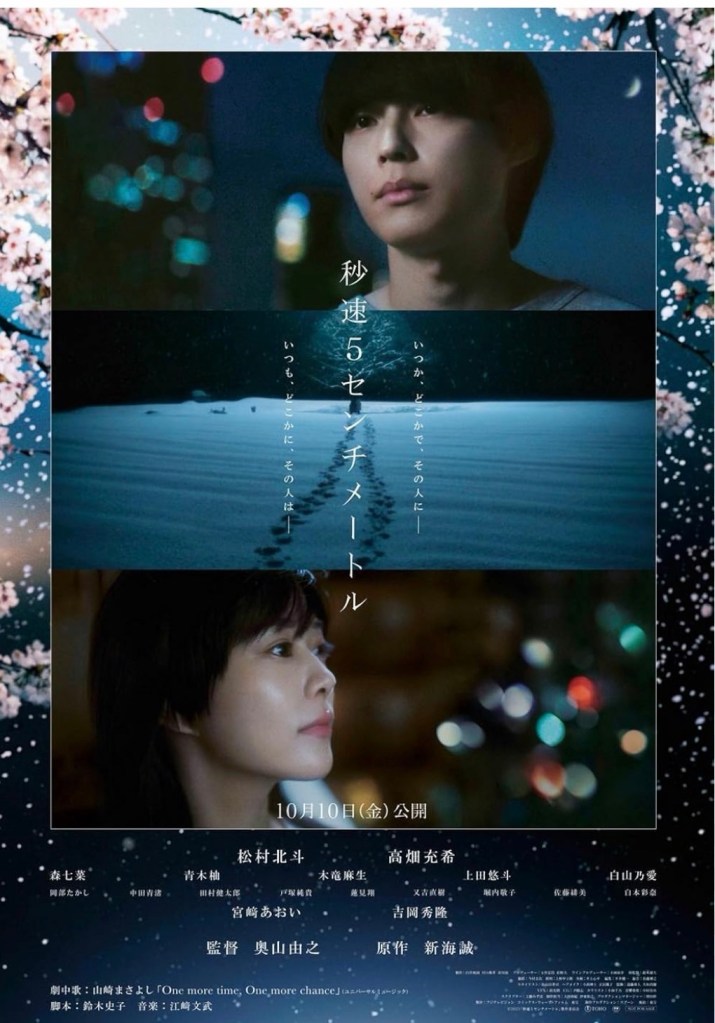
The original anime was a favorite of mine back in university (here, here, and here). The live-action version is slower-paced and still has beautiful cinematography. When I was younger, I thought the way Takaki sealed himself off from the world was cool. Now, though, I think it’s the easy way out.
The movie version presents Takaki in a more positive light, and he’s able to move on and likely live a more fulfilled life (the animate was more up to interpretation). While the anime hit me harder emotionally back then, I prefer the more hopeful and mature message in the film.
It reminds me of Cinema Paradiso. Life is complicated. Even if two people like each other and are meant for each other, they still might not end up together. Nostalgia becomes a part of us, but we still have to move on and live our lives in the ways we feel are best.
Sometimes life is like a dream. It doesn’t make much sense, yet is interspersed with beautiful melodies.
Chainsaw Man – The Movie: Reze Arc. Even though I’m not a fan of this type of anime, this movie does live up to its hype. The author managed to convey a lot in just a few scenes and explore love within a demon-oriented story. The background music and songs by Yonezu and Utada complement the movie well (here’s an analysis of the songs).
New Yorker at 100. Interesting documentary about the magazine and the “quirky, borderline obsessive” people working there, whether they are designing covers, drawing cartoons, or writing stories about people, films, or music. When I was a university student in Japan, I used to go to bookstores regularly to browse magazines and did it in libraries later. I was probably hoping that browsing magazines on topics I’m interested in, be they art, music, or technology, would make me a “learned” person in those fields. But the truth is just browsing is not enough.
Skyscraper Live. Alex Honnold climbing Taipei 101 free solo, an incredible feat in an amazing city. Free Solo and The Dawn Wall are both good documentaries about climbing. Here’s a review from The New Yorker.
You and I are Polar Opposites. I watched a few episodes. So far it’s been a fun, light-hearted animate exploring attractions, self-consciousness, and communications in teens.
Song by Stefanie Sun
Lyrics:
聽見冬天的離開我在某年某月醒過來
我想我等我期待未來卻不能因此安排
陰天傍晚車窗外未來有一個人在等待
向左向右向前看愛要拐幾個彎才來
我遇見誰會有怎樣的對白
我等的人他在多遠的未來
我聽見風來自地鐵和人海
我排著隊拿著愛的號碼牌
我往前飛飛過一片時間海
我們也曾在愛情裏受傷害
我看著路夢的入口有點窄
我遇見你是最美麗的意外
總有一天我的謎底會解開
I hear the winter leaving.
I wake up in some year, some month.
I think, I wait, I look forward to,
But that’s not how the future is arranged.
Cloudy sky, an evening, outside the car window.
There is a person waiting in the future.
To the left, to the right, to the front I look.
How many corners must love turns before it arrives?
Who will I meet, what are we going to say?
The person I’m waiting for, how far away is he in the future?
I hear the wind blowing from the subway and the crowd.
I’m standing in line, holding a number plate for love.
Cloudy sky, an evening, outside the car window.
There is a person waiting in the future.
To the left, to the right, to the front I look.
How many corners must love turns before it arrives?
Who will I meet, what are we going to say?
The person I’m waiting for, how far away is he in the future?
I hear the wind blowing from the subway and the crowd.
I’m standing in line, holding a number plate for love.
I keep flying and flew across a sea of time.
We both had been injured in love.
I’m watching the road, the entrance to the dream is a bit narrow.
Meeting you is the most beautiful accident.
One day, my riddle will unravel.
A nicely written book about his relationship with his father, kids, and running, from the CEO of The Atlantic. Here’s an essay adapted from his book. I share many of his sentiments toward running, and I’m grateful that I can still run whenever I feel like it and see the world while running.
Excerpts:
Every action we take helps to build our habits. Quit once and it’ll be easier to quite the second time too.
When I arrive in a new city, I like to circle it with a run. I’ve seen more of the world while running than I have while walking.
I learned that pain has physical causes but that it’s mostly a mental process: we slow in races less because we reach our physical limits than because our minds get scared.
Only the disciplined ones in life are free. If you are undisciplined, you are a slave to your moods and your passions. –Eliud Kipchoge, two-time Olympic marathon gold medalist for Kenya
The sensation of growing stronger is one of the most beautiful things about this sport. As my training intensified, everything about my body–and my awareness of it–sharpened.
She hadn’t touched money or bought anything for two months. Her life had been distilled to its essence: run, eat, sleep, repeat.
Running has become part of my day where I disconnect from screens and let my mind drift usefully and turn over problems. It encourages simple habits–heathly sleep, healthy eating, moderate drinking–that help as much at 8 a.m. meetings as they do 6 a.m. runs.
It taught me to have total trust in the compound interest gained by steady day-by-day work. I got fast by running hard, consistently, and wasting very little time worrying about how ambitious my goals were.
“Somewhere in this world, there are people who’ve put in that unimaginably huge amount of effort. And the fact that I’m still this small makes my heart race at the possibilities that exist in the space between us.” — Taiki



 Ryu's Blog