• Happiness

    People generally think it’s good to be happy, and many of us want to be happy and expect ourselves to be happy. But we seldom think about what happiness is. Is happiness a subjective state for the moment, or is it about life as a whole? Even if we know what it is, why should we value it highly or consciously seeking it anyway?

    A lot of self-help books around these days tell us what a happy life is and ways to find happiness. Some advices may give us insights to our life, but their doctrine of happiness shouldn’t be our expectation of happiness. Unrealistic expectation of happiness such as being happy all the time is unlikely to make us happier.  And since happiness is an abstract and subjective thing, we should find and give our meaning to it.

    Here’s a suggestion on finding happiness I came across lately from a review on a book about history of happiness. I think the suggestion is fairly sensible. See what you think.

    “Those only are happy who have their minds fixed on some object other than their own happiness: on the happiness of others, on the improvement of mankind, even on some art or pursuit, followed not as a means, but as itself an ideal end. Aiming thus at something else, they find happiness by the way.”

    -John Stuart Mill

  • Exams

    Exams are coming and they look scary

    Pressure is heightening and I feel worried


    Need to study and need to revise

    To be ready and to be wise


    Drinking lots of coffee as my mind’s getting weak

    Staying up like zombie but the future still looks bleak


    There’s no time and I know no rhyme

    Better stop blogging and get back studying


    So friends

    Don’t be surpirise if I disappear online

  • Not a pessimist

    I aim to be a better thinker; but find myself continue expressing muddled thoughts

    I aim to be a poised man, but find myself continue to be a clumsy, inarticulate guy

    I aim to be genuine and true to my heart, but find myself wanting to impress and show-off

    I aim to be a better writer, but find my writing inelegant, unfocused, and condescending


    Despair?


    No


    May have to hit more walls, make plenty of mistakes, or appear stupid, but I want to face my incompetence. One day I hope to be able to look back and see how far I’ve traveled and how much I’ve growth. Attaining the aims are nice, but not as important as seeing myself working toward them.


    “Hope” is the thing with feathers –
    That perches in the soul –
    And sings the tune without the words –
    And never stops – at all –

    And sweetest – in the Gale – is heard –
    And sore must be the storm –
    That could abash the little Bird
    That kept so many warm –

    I’ve heard it in the chillest land –
    And on the strangest Sea –
    Yet, never, in Extremity,
    It asked a crumb – of Me.


    -Emily Dickinson

  • Hotpot in Winter

    Several Thai friends in Cambridge arranged a surprised  hotpot party for my belated birthday. It’s totally unexpected, and they ingenious led me to it (I guess I lack the  detective instinct of Holmes or Konan). Gathering around a pot, eating and chatting with a bunch of friends was great and gave warmth to the winter. It reminded me of Thailand’s MK and  the uncountable Suki parties my friends and I used to have around these time of year back in Japan.  Nothing beats a hotpot party in the freezing winter.
  • Interdependence

    This is a reflection on a friend’s comment. I don’t know why MSN space wouldn’t allow me to reply to people’s comments; another thing for Microsoft to improve.


    I agree that society has lots of rules that we’ve to abide to. The implicit types of rules like others’ expectations and values (which usually reflect in salary or price) are the ones we most likely feel pressure about. The society rewards certain things more than others. Since society is made up of people, it means people demand these things more. We live in a world where we’ve to depend on other people on almost everything: foods, services, entertainments, etc. People we depend on are mostly people we have no relationship with; they work not for us, but for their own living. And money is a way society rewards people’s productivity and gives them more motivation to work in things others value. If there are no commercial values, most people may go for artistic or other pursuits they find satisfying, but who’ll produce things other people need? Higher pay jobs may not be more meaningful or valuable, but they exist because people demand them, and one reason some jobs are highly reward is because the job’s intrinsically undesirable (boring, long hours, dangerous, etc.), and people are compensated for it. Maybe that’s why we use the term compensation.


    Drawing what one likes is great, but how much does it contribute to others? I’m generally for the individualist, and I don’t believe we should live life for others’ sake. But since we live in a world where we’re dependent on others in one way or another, we have to produce something (or alternative depend on our family’s work). If we live alone, then we won’t have to follow society’s rule, but we will have to grow our own foods, provide our own shelters, and use the spare time left over for leisure and to do things we like. It’s the same. I think we can definitely follow our dreams and imaginations, as long as we’ve a way to support our dependence on others by producing something people need. Money became a shorthand in our world to mean many things: success, productivity, greed, usefulness, etc. Sometimes people lost sight of what it is. I never think it’s rational to go after money for its own sake. What we want is the things or services behind, and we have to find ways to exchange ours with others. It’s definitely a constraint, and there’re trade-offs to make as long as we’re living with other people. But it doesn’t prevent me to follow my way of life if I find it worthy enough.


    All mankind is of one author, and is one volume …No man is an island, entire of itself; every man is a piece of the continent, a part of the main”


    –John Donne

  • moonlight fantasy

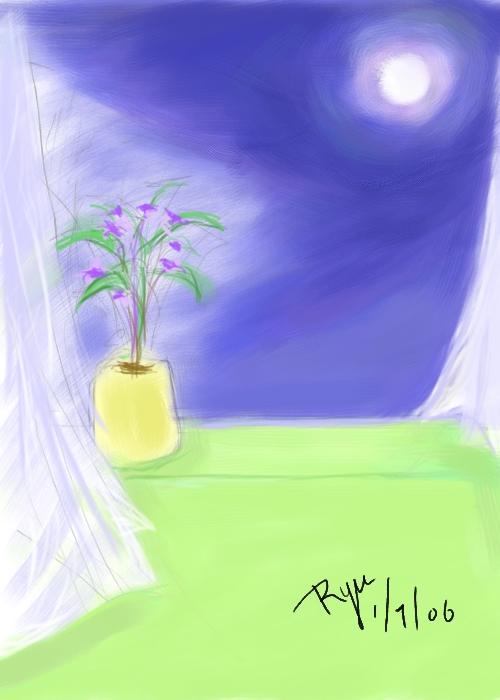
    Looking at the beautiful moon outside my window, I lost in my own world. I like to think of the moon as an elegant and mysterious lady. Fantasy maybe, but it makes no difference to me which way I’d like to see it. Why not think of Venus as a place full of love instead of a cold and gloomy place. Why not think of the wind as my friend instead of just some natural motions (at least when I’m not studying about it or wandering near a tornado). In fact, we beautify things all the time, whether they’re past experience we’d like to go back, or a possible future when we’re happy, free, and do things we love. Think about the beach, and we usually conjure up beautiful scenery and wonderful time but not the dirty garbage that lies around. It’s a psychological mechanism that probably exists to fill some of our needs.

    Unrealistic and unscientific? Maybe, but what’s science then. People don’t like chaos, and science is one way we use to explain things and bring order to the world. Generally things are considered scientific when they’re falsifiable. If tomorrow gravity disappears, or the sun doesn’t rise, then we will have to develop new ways to explain things (and no one can be sure those things won’t happen). Fairy tales, horoscope, destiny, all those fantasies are not consider science because so far we haven’t find ways to proof or disprove them. Since scientific views are developed with more systematic and rigorous methods, they are less likely to be nonsense than their alternatives, and they’re a convenient way to help us perceive and operate in this world. That’s why I wouldn’t try jumping out of a hill believing I can fly, or giving up my studies and believe some goddesses will lead me through my exam. Not that they are impossible, but I know what are likely to follow. But for many other things that no one know whether they’re true or not, or the truth doesn’t really matter to our life; why not see them in ways we like.

    It’s good to retain a child’s heart in a part of us no matter how old we are. Dreams, imaginations, spontaneity and unlimited possibilities can give rewarding experience compare to being logical or practical and follow scientific ‘proven’ ways of life all the time. I am attracted to people who daydream and find them charming in some ways, and I admire people who’ve a sense of humor. To have a sophisticated sense of humor is a talent and very much like art. I don’t have much talent for it, but at least I can comfort my child in me whenever I daydream and get lost in my own fantasy world thinking the moon as my lovely mistress. Why not?

  • I recently received a fwd mail that had a link to a psychology test on “my true color”. Like most tests, this one gave gratifying descriptions on what kind of person I resemble: serene, mysterious, perfectionist, determined, symbol of success, etc., and a few things to watch out (my color is black by the way). I would feel good if what they said is true, but since my undergraduate thesis involved psychometric methods and research, I doubt the reliability and validity of this test.  I used to like doing lots of psychology tests on all sorts of areas like personality, temperament, IQ, careers and talents. Although a few of them are widely tested and appears to be valid and have good theoretical foundations, I’m now skeptical to many of the tests’ results.

    But I guess truth is not why we do these tests; many people enjoy them even if they’re not sure whether the results are true or not (horoscope fit this description too; I used to read about it a lot, but I guess I should save my view about this topic for another time). Maybe we want to see what others have to say about us, want to learn more ourselves, or want confirmation about who we think we are. It’s interesting how the classification from the test results can give us a sense of identity. We feel it’s specifically for us even though we know many others are getting the same result. We want to be different but not too different. We want to be similar to people we like but different from the majority. We want to be unique in some ways and want to be above average (it’s shown that most people tend to believe they’re above average compare to people with similar backgrounds, but how can most people be above average if average is indeed average?) Well, I guess there’s little harm in trying out these tests (I just did one), but trying to find some sort of answers, identity, or confirmation through these tests are probably not too sensible.

    One of the New Year gifts I just ordered for myself is a book related to intelligence called Flowers for Algernon (also bought another book on political economy by Brittan, but I’ll spare you the detail on that); it’s a science fiction I think would be interesting and insightful to read (http://www.amazon.com/gp/product/015603008X/qid=1136486654/sr=2-1/ref=pd_bbs_b_2_1/002-3857489-3248819?s=books&v=glance&n=283155). What’s intelligence anyway? Is emotional intelligence a kind intelligence? How about musical, athletic, or creative talents? Is there one fundamental intelligence such as those measured by IQ test or are there many different kinds, such as the seven multiple intelligence proposed by psychologist Gardner? Is it innate or can it be improved? Intelligence is not a well-defined concept and is definitely hard to measure (just look at all the different IQ tests exist). Even though some of  the tests around show consistency in their predictions (e.g. high IQ correlate with better grade), what they’re really measuring are vague.

    Like many things I concern, I want to know more about intelligence so I can improve mine if possible. But why do I want to be smarter anyway? It’s probably not the absolute level of intelligence I care about, but how mine compare with others (in fact IQ is measuring on a relative basis with 100 being the average in most case). Let’s assume that intelligence is how we perceive the world, comprehend what our senses take in, and make use of these information, so the more intelligent people will think about things in more different ways and at different levels, seeing things and relationships other people don’t. That sounds nice, but would that make my life happier? The more I see things differently from others, the less other people will be able to understand me, and the more isolated I’ll be from others. To experience the world in such a way no one else can and see things differently from friends, family, or other loved ones can be scary. But luckily (or sadly), I guess I don’t have to worry about that for now.
  • Art of Balance

    Emerson once said that “We are always getting to live, but never living.” We know it’s important to enjoy the present since life’s short, and we never know what’ll happen tomorrow. After all, it’s only possible to live happily ever after on a moment-to-moment basis.  If ‘now’ is what matters, do we need goals, plans, or a New Year resolution? I think there’s a role for them. They help us think about what things we want, why we want them, and how we can achieve them. They act as a guide and help us plan what to do in the present. What we do today will have an impact on our life in the future. And as long as we’re alive, tomorrow will arrive, and future will become present.

    Life is about striving a balance: balance between now and future, planning and living, between time spent on my ambitions and time for other people, between working hard toward my goals and enjoying the moments, and between taking my dreams seriously and learning to laugh at myself. It’s also a balance between self-control and spontaneity, honesty and compassion, generosity and thriftiness, caution and boldness, and feeling and reason.

    Some of them may not be compatible at the same time, but I believe they’re not incompatible.  Balancing them and deciding when to focus on which in order to make life most enjoyable for both the present and the future is an art I’m learning about.

  • Footprints

    footprints

    This earth occupies an infinitesimal space in the universe

    I’m just one among billions of people in this world

    And the time I live in is only a tiny segment in the entire history

    So does another year matter?

    Does what I did in the past year matter?

    What I did, do, or plan to do

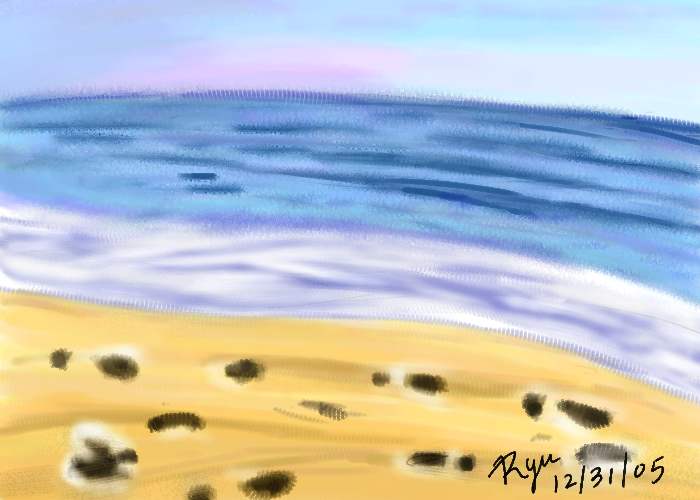
    They’re like footprints on the sand

    Will be washed away in a blink of eyes

    Though tiny and insignificant

    These footprints are seen by those

    Who happen to live with me in this same time, in this same space

    Whom destiny brought our lives together

    A coincidence, a crossing of lives

    So short and so insignificant in the eyes of the world, the universe, and time

    Yet it’s everything I have

    I’ll continue leaving footprints

    When they become meaningful to people around me

    My walk in this world will have meaning as well

  • Pride & Prejudice

    Since I had a productive day and did considerable studies, I rewarded myself with a movie that I recently downloaded and have wanted to watch since it’s released, the recent adaptation of Jane Austen’s Pride and Prejudice. The movie’s nice. Both the actors and the interpretation of the novels are quite good, and there’re many beautiful scenery in it. But I still prefer the 1995 drama series played by Colin Firth more. But the drama’s about three times as long as the movie, so probably it’s unfair to compare them.  Nonetheless, it’s always nice to watched different version of a story I like, especially when it one is well make (I even watched the Indian version of it—Bride and Prejudice—but that’s more an accident than a conscious choice).

    So what make me like this story so much? I like Austen’s portrayal of the different characters, their wits and use of words, and the style of the romance. I especially like the main character in her story. Darcy’s one of my favorite characters, so is Knightley, the main character in Emma (another novel by Austen). Her protagonists are men who I can identify with and admire. If I were to live in those times, I’d probably want and strive to become these kinds of men. Even for our time, I think there’re many admirable qualities to be found in those characters.

    Lovely novels, I ought to read them again sometime.