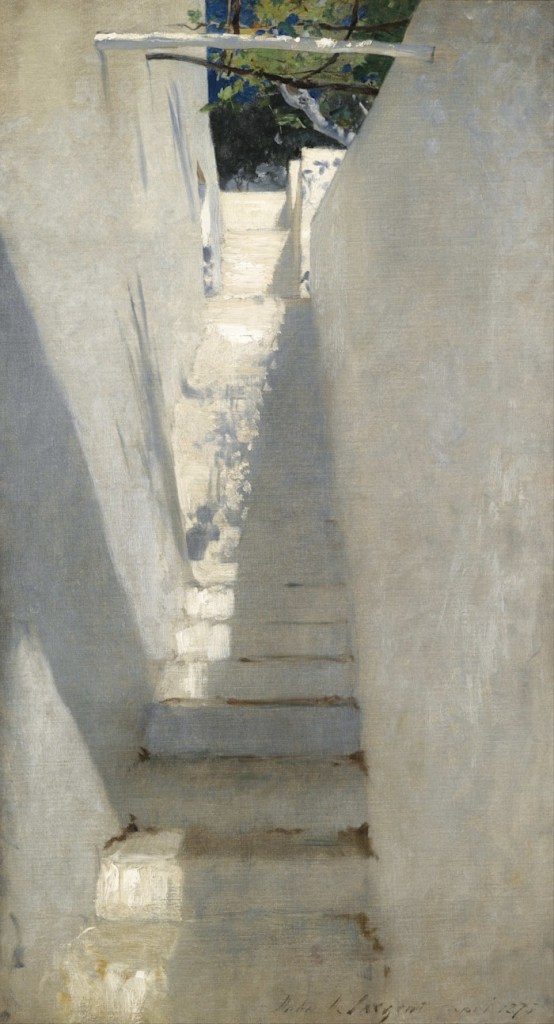
Staircase in Capri’ (1878) by John Singer Sargent from the FT article
Nichol Chan argues that our desire for efficiency and optimization can crowd out what matters to us.
For things I value, such as relationships or a craft, focusing on quality and being present often helps. Reflecting on my experiences and shaping them into a narrative also helps me slow down. Perhaps the distinction is to optimize what is instrumental while being present with what is intrinsically valuable. For more instrumental things, I’m happy to optimize with simple routines I can follow most of the time, while leaving room for exploration and serendipity. And periodically reminding myself that all things are transient makes optimization seem less important than treasuring them while they last.
P.S. Being more playful and playing games just for fun also helps.
Excepts:
It’s no longer about whether something feels meaningful or enjoyable. We start looking for the fastest way to learn, the smartest routine to follow and the most productive way to unwind. At some point, even rest becomes another thing to improve.
…
As a self-confessed Type A personality, I rarely leave an interest alone for long. If I pick up a new hobby, I find myself asking whether it could become content or a side hustle.
…
The danger isn’t that my generation no longer values friendship, creativity or simply being present. It’s that optimisation quietly changes what earns our attention.
…
If optimisation is the mindset, technology has become its greatest enabler.
…
In theory, all of this should create more space for the relationships, hobbies and slower experiences we claim to value. Instead, it creates new expectations to do even more. Long before ChatGPT, sociologist Richard Sennett warned that societies obsessed with speed and flexibility slowly erode the qualities that take the longest to build: patience, craftsmanship, commitment and even a stable sense of self.
…
And that’s the paradox. We built these tools to give ourselves more time for what matters, yet they often make it harder to choose exactly those things. The challenge was never that we lacked time. It was that we’ve come to believe every spare moment should be put to work.
…
That’s the contradiction at the heart of the age of maxxing – we say we still value creativity, deep friendships, craftsmanship and community. We just keep building lives that make those things harder to practise.
P.S. Enuma Okoro on not needing to be productive on holidays: “It makes me think of how rarely we take time or have the opportunity to pause and really think about the kind of holiday (or even just day off) we need or desire.”
P.P.S Japan’s ongaku kissa (music cafes) provide a space for people to be present and just listen to music.
 Ryu's Blog
Leave a comment