Over confidence and in particular the idea that we are special and will live a long life suggests the error is saving too much. Note that we also tend to think that our partner will be alive as well. My wife once asked me whether we were saving enough for “our” retirement. “Sure,” I said, “don’t forget one of us will probably die before the other and I’m not saving for your future husband.” “Why,” she replied with a sigh, “can’t economists be more human?”
-
I like the way economists think:
-
People tend to do New Year resolutions but few reflect upon them until the next New Year. But tracking progress is as important as setting the right goals as it not only reminds me of my goals but also allow me to adjust my plans if necessary (here and here are my resolution entries for this year).
Lately I haven’t been following my plan/schedule closely (hence less blogging, drawing, and serious reading) and probably have spent too much time on hedonic pleasures such as dining out, movies, and passive reading than on learning and creating things. Below are some thoughts on various aspects of my life. Overall I think I’ve passed the minimum standard in living the way I want but I definitely could do better.
Career: B-
Became much more familiar and efficient with my work. Now have to further develop my economic and financial knowledge and find ways to add more values.
Health: A-
Exercise and eat well enough to keep myself healthy (except having too many desserts on weekend). Probably not as fit as I’d like ideally, but that’s not my goal for now as I think the time and energy are better spent elsewhere.
Friend: C-
Haven’t catch up with friends that often and probably should communicate with them more regularly, especially those not living in Singapore. But it’s comforting to know that with certain friends, I can connect with them easily and feel close to them even without frequent contact (or perhaps just an excuse).
Love: D-
Only reason it’s not an F is because I didn’t explicitly set it as a goal. But as far as I can see, there’s little probability in meeting someone I’d like. My work environment, personality, and idealistic views greatly limit my chance of meeting new people and finding someone I like. Don’t think I’d do much about it for now except to continue better myself and keep an open mind.
Learning: B-
Read enough to feel that I’m learning something everyday. But the readings are quite random and spontaneous. Would probably be more effective if I specified my learning goals and follow them systematically.
Hobbies: B-
Similar to the learning goal, I’ve been dabbling in various hobbies but haven’t focused enough to do something particularly well. I plan to set some specific projects to do for each month to ensure I’m creating something regularly.
Finance: B
On track to repay my Grad school loans soon, even taking into account my travel plans and regular fine dining. Though still feel a bit guilty about my indulgence given I’m in debt. I guess my Chinese background makes me place more value on prudence than on consumption smoothing.

-
From Marginal Revolution:
It may be that friendship is nourished on observation and conversation, but love is born from and nourished on silent interpretation…The beloved expresses a possible world unknown to us…that must be deciphered.
That is Gilles Deleuze and it is the front quotation in the new novel Atmospheric Disturbances, by the very beautiful Rivka Galchen. The key premise of this novel is that a 51-year-old psychiatrist suddenly believes that his wife has been replaced with an exact look-alike; he refers to her as the Simulacrum. I read it straight through. Here is an interview with the author.
Silent interpretation – make sense to me as I think most love happens in the mind.
-
A belated birthday portrait for a far away friend who just moved to a new apartment alone for her first job. Wish she will enjoy this new chapter of life and continue to smile while facing life’s challenges.

-
A movie for someone who likes music, dreams, or fariy tales.
-
Mindset by Carol Dweck. The ideas of the book’s simple: We can change our mindset and a growth mindset is better than a fixed one. I found this book too much of a self-help nature for my taste. Reading about her research is much better than reading this book (for example, see here and here).The Happiness Myth by Jennifer Michael Hecht. One of the more sophisticated books on happiness. Full of wisdoms drawn from literature, history, science and philosophy. It leads one to question many of the absurdities we take for granted in life and helps put things in better perspective. This is a book I’d probably read again.
After Dark by Haruki Murakami. I got the Japanese version and still figuring out how to get the most out of it. I find it much harder to understand/enjoy fiction written in a second language.
-
The main characters and the theme motivated me to watch this drama (the ending song ‘Canvas’ by Hirai Ken is nice too). I wasn’t sure whether I’d like it at first, but it gets better the farther into the story. The drama, based on a magna, portrays the college life of 5 art students. It touches upon themes that many people experience in their teens: friendship, love, passion, self-doubt, career direction, and separation. Some people don’t know what they want to do in life. Some know what they want but don’t know how to reach it or doubt whether they have what it takes. Others are confident in their ability but can’t find a place in the world that suits them. Idealist and people who can’t seem to grow pass their teenage mindset would probably like this drama.
Life would be much easier if we all have a map telling us where to go. The problem for many is that we don’t know where the goal is. And even when we think we find ourselves a goal, we often have doubts: Is it really what I want? Is it realistic and reachable? What should I do to make it happen? Do I have what it takes to make it happen? Is it really worth it (and back to the question is it what I really want)?
If we are lucky to figure out what we want in life, be it money, love, comfort, or status, there are still myriad of ways to get there. And we often don’t know which ways suit us best. We want a map in addition to a goal. Knowing where to go seems more important to me than knowing how because we can change course and move in a different direction as long as we keep the destination in mind. So the bigger problem seems to be self-doubt.
We feel frustrated and dissatisfied when we can’t seem to be able to put in the effort to live a life we want. We know that not just the process, but outcome matters as well. We also know that, contrary what many self-help book would like us to believe, there are things we can’t achieve no matter how much efforts we put in or have the correct mindsets and methods. Should we try or not, continue or give up? Will it be worth our efforts, time, and other sacrifices?
There is a time in every man’s education when he arrives at the conviction that envy is ignorance; that imitation is suicide; that he must take himself for better, for worse, as his portion; that though the wide universe is full of good, no kernel of nourishing corn can come to him but through his toil betowed on that plot of ground which is given to him to till. The power which resides in him is new in nature, and none but he knows what that is which he can do, nor does he know until he has tired.
–Ralph Waldo Emerson
-
Came across many interesting articles on Japan throughout the week. Japan is an interesting place with lots of extremes in both the positive and negative. I like the country and Japanese food remains my favorite cuisine.Diary on Japanese food. Don’t miss the Monday’s entry on Japanese dining (and toilet) culture.Japanese retail is not inefficient. I agree. Services in Japan are among the best I’ve seen.Tyler Cowen’s list of favorite Japnese movies. Kurosawa and Ozu’s movies are great. I also like most of Miyazaki’s anime. I’d add Shinkai Makoto (here’s an earlier entry) into my favorite.I rewatched Lost in Translation recently and still like it a lot. I’m planning to take a week’s trip to Japan later this year. Can’t wait to explore the place with a JR pass.
-

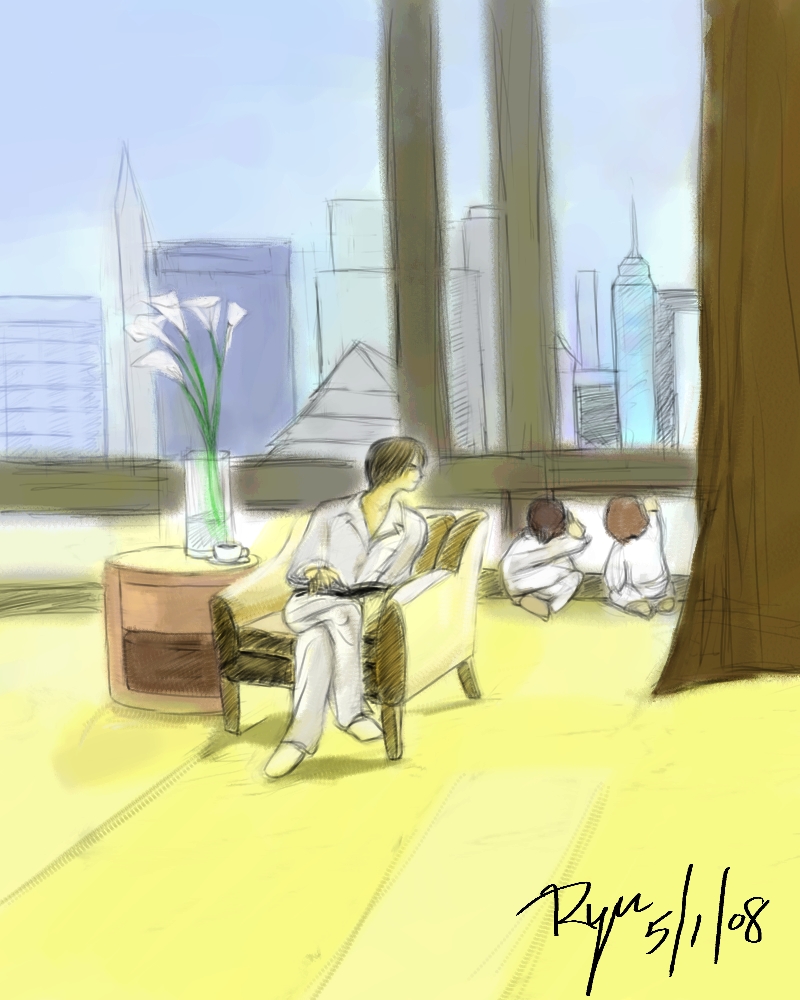
This is the title of an advertisement I came across recently (drawing above). It portrays an ideal lifestyle. Work hard in a job we love and good at, gather with friends and family over a decent meal and a cup of coffee on weekend, or travel outside the city for a holiday break are some lifestyles people idealized, not to mention the more materialistic ones.
So why don’t more people actually living the lifestyle they want instead of idealizing something better in the future? Are time and money the constraints? Besides the highly monetary and status/recognition-related desires, most idealized activities are not hard to do. Perhaps we don’t enjoy them as much as we think. Or perhaps we want something to look forward to, and having an idealized future is a way to deceive ourselves to believe that future could be better. Or because once the ideal becomes attainable, it loses its glamour and hence our actual lifestyle never match the ideal one.
Having an ideal makes good evolutionary sense as it drives us to work hard and could give us a sense of purpose in life, even though the ideals always remain elusive. People who are satisfied with their life are either good self-deceiver (in a positive sense) or who’ve think through what they want to associate themselves with and live a life that’s consistent with those stories.
Since lifestyle is a habit, I don’t think it can be changed easily even if one suddenly becomes very rich and has lots of time. Instead of the unrealistic view that someday in future we’d attain our ideal lifestyle, I think it makes more sense to improve one’s quality of life step by step by shifting our mental view and lifestyle gradually toward the ideal one. We might not be able to change our personality much (and it’s likely to be an important determinant of one’s satisfaction with life), but we could gradually change our mental states, living styles, and habits to better match them with our ideal lifestyle. When the two match, will we be satisfied? Or we will we be dreaming of other ideals? Either way our life should have improved.