-
Never Split the Difference provides useful advice on being a more effective communicator, a bit like the modern day version of Carnegie’s How to Win Friends and Influence People.
Here are some quotes:
It all starts with the universally applicable premise that people want to be understood and accepted. Listening is the cheapest, yet most effective concession we can make to get there.
The goal is to identify what your counterparts actually need (monetarily, emotionally, or otherwise) and get them feeling safe enough to talk and talk and talk some more about what they want.
But neither wants nor needs are where we start; it begins with listening, making it about other people, validating their emotions, and creating enough trust and safety for a real conversation to begin.
…everyone you meet is driven by two primal urges: the need to feel safe and secure, and the need to feel in control.
Research shows that the best way to deal with negativity is to observe it, without reaction and without judgment. Then consciously label each negative feeling and replace it with positive, compassionate, and solution-based thoughts.
These seem to be universal principles. The book also provides tactical advice on how to be a better negotiator:
All negotiations are defined by the network of subterranean desires and needs. Don’t let yourself be fooled by the surface.
Negotiation is not an act of battle; it’s a process of discovery. The goal is to uncover as much information as possible.
To get real leverage, you have to persuade them that they have something concrete to lose if the deal falls through.
Robert Estatbrook once said, “He who has learned to disagree without being disagreeable has discovered the most valuable secret of negotiation.”
When someone seems irrational or crazy, they most likely aren’t. Faced with this situation, search for constraints, hidden desires, and bad information.
Ask calibrated questions that start with the words “How” or “What.” By implicitly asking the other party for help, these questions will give your counterpart an illusion of control and will inspire them to speak at length, revealing important information.
Before you head into the weeds of bargaining, you’ll need a plan of extreme anchor, calibrated questions, and well defined offers. Remember: 65, 85, 95, 100 percent. Decreasing raises and ending on nonround numbers will get your counterpart to believe that he’ squeezing you for all you’re worth when you’re really getting to the number you want.
This advice might help make others feel better about us. And if we do it consistently, perhaps it’d become second nature and make us a better person.
But to what extent do we want to be a ‘good communicator/negotiator’ in front of people we have known for decades?
Communication is something I value. Without proper communication it’s hard to have a real relationship. I believe two reasonable people who share similar goals should be able to talk through anything. But humans aren’t rational. Sometimes we have different views on what we think would be best. Other times we might not have the capacity to even talk through an issue calmly.
In an economist’s world, where everyone’s rational, things would be simpler. But it’d likely be a less pleasant place to live. Perhaps AI would change that. Many might opt to live in a world where AI can guide them to present their best self and make the best decisions, like what many salespeople learned to do in front of clients. While this might work for casual encounters, it’s less clear for personal relationships. We would like to think that after spending many years together, we should be able to understand each others’ individuality better, accept their strengths and weaknesses, and be able to ‘be ourselves’ without much filter. But is it true?
One attraction of being a self-sufficient artist, especially for those who focus on solitary activities, is that it doesn’t have to involve others. It provides a way to get lost in something for a while without having to deal with the messy world.
Would I rather live deeply and take all its ups and downs, or take the easy way out to live in solitude, or perhaps follow the Buddhist way of taking in everything in a detached way, knowing that all is transient?
…it is with great truth that Aristotle says, To be happy means to be self-sufficient. For all other sources of happiness are in their nature most uncertain, precarious, fleeting, the sport of chance…And in old age these sources of happiness must necessarily dry up: –love leaves us then, and wit, desire to travel, delight in horses, aptitude for social intercourse; friends and relations, too, are taken from us by death.
Schopenhauer -
I’m approaching midlife. Many people have midlife crises as the life they are living turns out to be different from the life they want. And unlike their younger self, their options become more limited.
As Kieran Setiya put it nicely in his book: “I look back with envy at my younger self, options open, choices not yet made. He could be anything. But I am condemned: course set, path fixed, doors closed…Aging is a corporeal symbol of the progressive diminution of prospects”
While we can’t turn back the clock, Setiya provides some advice: care about something other than yourself and focus on atelic activities (things we do for their own sake and not as a means to achieve a particular end).
How about losses and regrets? Setiya believes they are essential parts of life: “To wish for a life without loss is to wish for a profound impoverishment in the world or in your capacity to engage with it, a drastic limiting of horizons…There is consolation in the fact that missing out is an inexorable side effect of the richness of human life…”
As we get older, we might have a different problem. According to Schopenhauer:
Disillusion is the chief characteristic of old age; for by that time the fictions are gone which gave life its charm and spurred on the mind to activity; the splendors of the world have been proved null and vain; its pomp, grandeur and magnificence are faded. A man has then found out that behind most of the things he wants, and most of the pleasures he longs for, there is very little after all; and so he comes by degrees to see that our existence is all empty and void.
In midlife we want a different life that couldn’t be, while in old age we discover that everything is meaningless.
But we are not doomed. Research suggests older people tend to be happier and more content with their life.
I think if we keep the end in mind and focus on what’s important, we can be content with life at any age. Perhaps because I already had a quarter life crisis, midlife hasn’t been a game changer for me. I’m grateful that there are still things to forward to, people I care about, and things I enjoy doing for their own sake.
An old friend reminds me that it doesn’t take a lot to make another person’s life more meaningful: a bit of humor, thoughtfulness, and kindness are all it takes.
-
From Berkeman’s book:
An alternative, Shinzen Young explains, is to pay more attention to every moment, however mundane: to find novelty not by doing radically different things but by plunging more deeply into the life you already have. Experience life with twice the usual intensity, and “your experience of life would be twice as full as it currently is”–and any period of life would be remembered as having lasted twice as long.
We might seek to incorporate into our daily lives more things we do for their own sake along–to spend some of our time, that is, on activities in which the only thing we’re trying to get from them is the doing itself.
…when presented with a challenging or boring moment, try deliberately adopting an attitude of curiosity, in which your goal isn’t to achieve any particular outcome, or successfully explain your position, but, as Hobson puts it, “to figure our who this human being is that we’re with.” Curiosity is a stance well suited to the inherent unpredictability of life with others, because it can be satisfied by their behaving in ways you like or dislike.
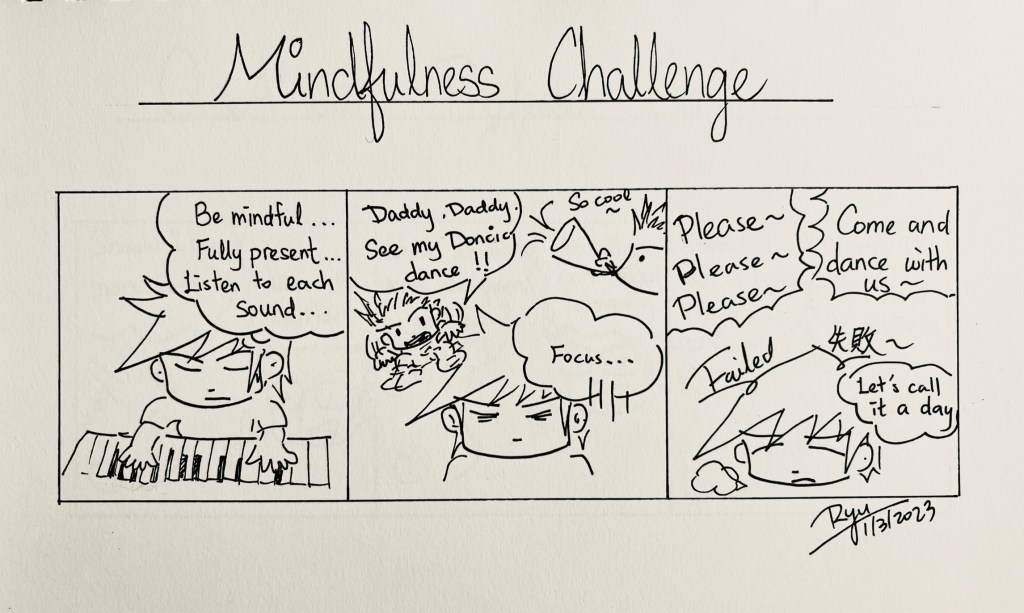
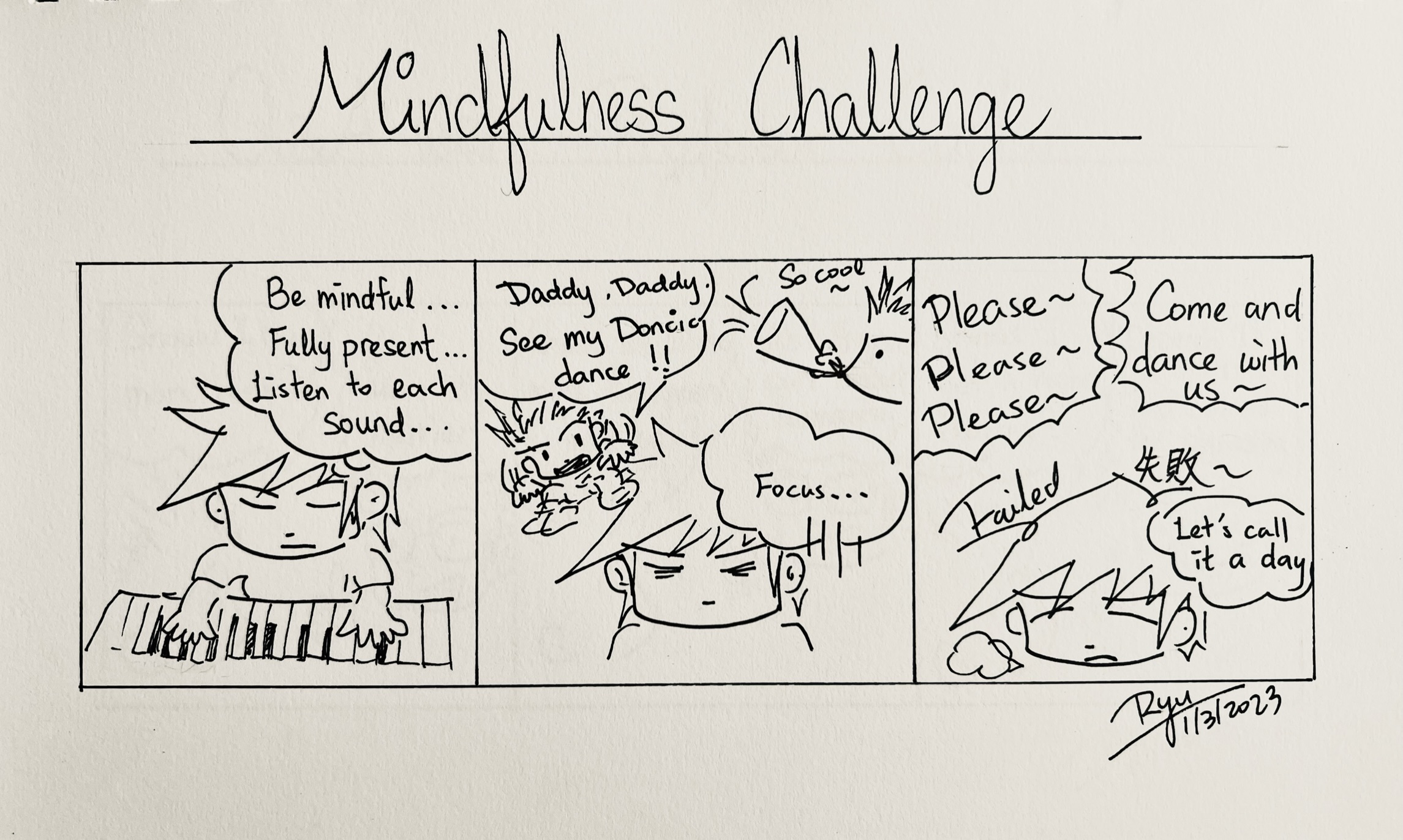
One of my aims this year is to be more mindful in my daily activities. More attention; less multitasking.
-
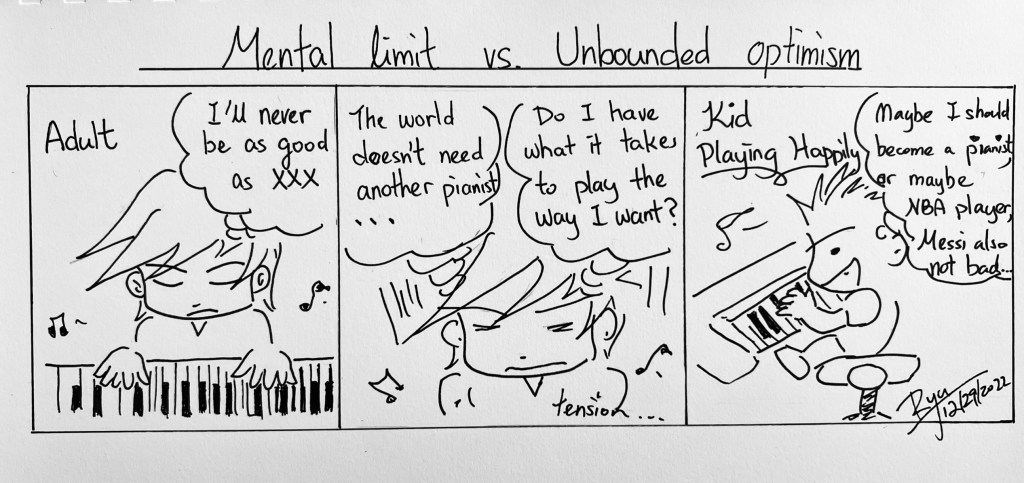
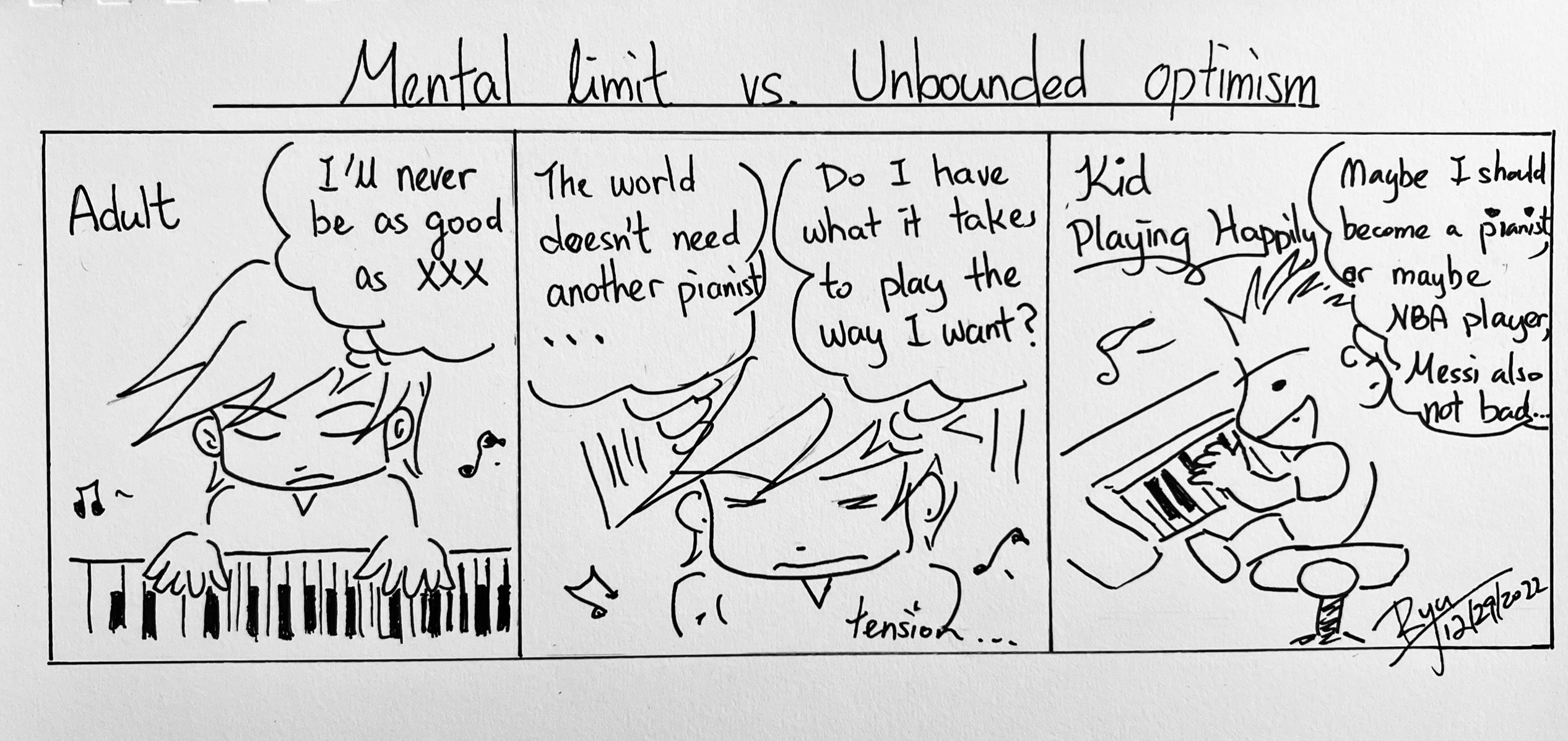
I started learning piano around the same time as my kids. It seems like they have different mindsets and perceptions of time. My boys don’t seem to have the same urgency to get results, nor do they get affected much by other good performers. In contrast, adult beginners tend to want results more quickly and have high expectations from the beginning.
I like this passage from The Art of Practicing:
Comfort, ease, and joy can be cultivated through practice. To do this, we must give up excessive ambition and the desperate struggle for results, and let ourselves feel the pain of our longing, of having to wait to make music the way we want to. We can learn to relax with this longing and to enjoy its soft, warm presence in the heart.
Presence is the state of being fully present, of body, mind, heart, and sense perceptions being completely engaged with the activity of the present moment. For a performer, this means not only being engaged with the music but letting the energy of the audience affect you. In practicing, it means being at ease in your surroundings and being aware of each movement and each sound that you make.
It’s a good reminder to be more present during daily practice, patient with results, and to cultivate a sense of relaxed longing.
-
My resolutions, if they exist, generally revolve around 1) getting better at certain activities, such as piano, Wing Chun, and basketball, or 2) developing certain habits, like meditating and journaling daily.
On getting better, the challenge is to 1) set up a routine for regular practice, and 2) be conscientious enough to focus on areas that’d help me improve. The latter is more difficult, as activities that’d likely help me improve most tend to be the less exciting drills, self tests, and evaluations that are not well-defined and require mental efforts.
I would also like to set a regular time to review things. Without reviews, I forget many things, including experience, books I read, or movies I saw. I hope this blog can help me to be more reflective of life events and media consumed, and be more organized with my photos, videos, and drawings. This in turn might help me remember the more important things in life.
Matthew Mcconaughey kept a diary for 35 years, and this is what he said when he reviewed them to write his memoir: “I enjoyed myself more than I thought I would. I laughed, I cried, I realized I had remembered more than I expected, and forgot less.” I’m not sure my memory would be as good as his, but I think my future self would love to read my real time feelings and thoughts.
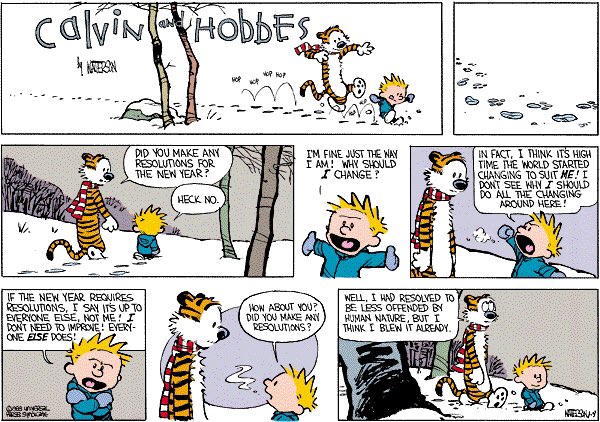
Most people don’t stick to their resolutions beyond February, and I’ve failed many times (e.g. regular review has been a challenge). But life is a journey. If I fail, I can be more like Calvin and be content with myself.
-
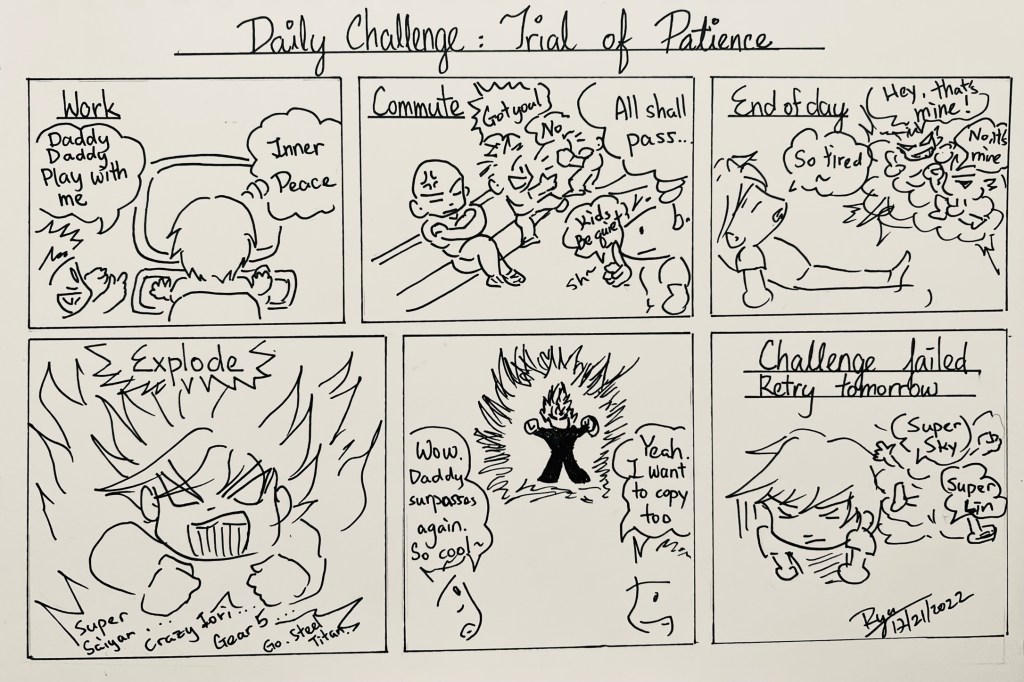
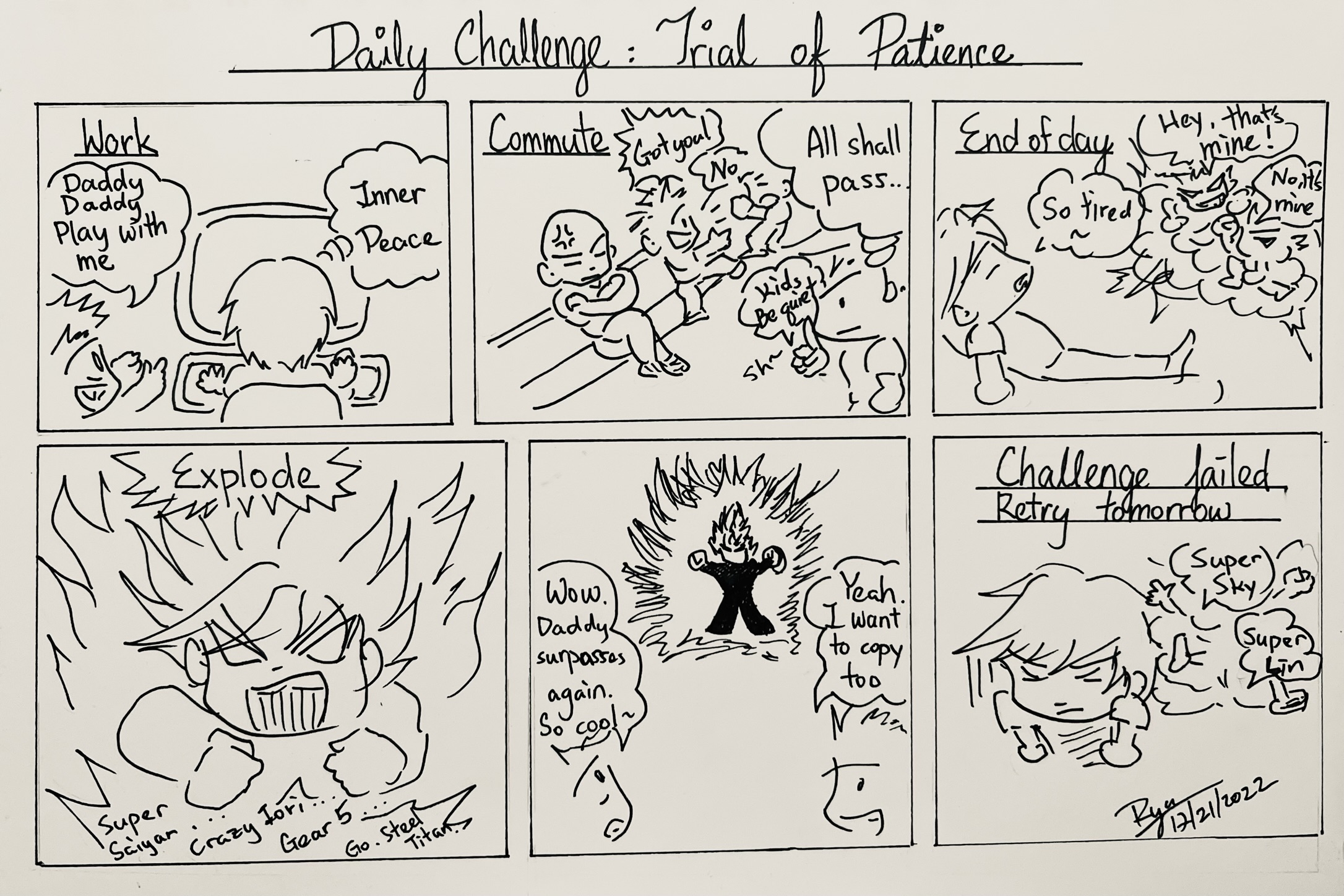
Kids are a source of wonders, but also frustrations.
Traveling with young kids can be extremely taxing, but they also create great memories.
Luckily, in most cases we tend to remember the good times, and forget the daily frustrations.
Or in Kahneman’s terms, our experienced self might feel stressed, but our remembering self will thank us for creating those special memories.
I often remind myself to take a long view, focusing on building good relationships while downplaying the daily, short term stuff that annoys me. But it’s easier said than done.
It’s a constant challenge.
 Ryu's Blog